What Makes Mango Wood a Great Choice for Solid Wood Furniture
People shopping for solid wood furniture spend their time weighing oak against walnut, or wondering whether teak is worth the price. Mango wood rarely enters that conversation, and that's a gap worth addressing. Understanding what makes mango wood a good choice for solid wood furniture starts with looking at the material honestly: it's hard enough for daily use, visually expressive in ways most hardwoods aren't, sourced without contributing to deforestation, and priced well below the woods it competes with aesthetically. At Mercer & Gray, we didn't choose mango wood because it was convenient. We built our collections around it because, once you understand what this material actually is, the case for it becomes hard to argue with. This article covers what mango wood is, how it performs against common furniture woods, what it looks like in finished pieces, and what to know before you buy, honestly, without overselling.
Why mango wood starts life as a fruit tree, not a timber crop
How the mango tree's fruit lifecycle creates timber
Most furniture-grade hardwood is grown and felled specifically for that purpose. Mango trees work differently. A mango tree produces commercially viable fruit for roughly 15 to 20 years. Once fruit production declines past the point of agricultural usefulness, the tree gets harvested. The timber is a byproduct of that agricultural cycle, not the reason the tree was planted in the first place. Without a furniture industry willing to use it, these trees would largely be burned or left to rot.
That distinction matters far more than most furniture brands acknowledge. Mango wood's sustainability story doesn't depend on certification language or corporate pledges. It's structural: the wood exists because of fruit farming, not because forests were cleared for timber. That's a fundamentally different supply chain than oak, teak, or walnut, where the tree's primary value is the wood itself.
What responsible sourcing looks like in practice
FSC certification is a reasonable signal to look for when buying mango wood furniture. It confirms chain-of-custody tracking from the forest through to the finished piece. That said, FSC certification is voluntary in the US market, and its absence doesn't automatically mean a brand sources irresponsibly. What matters more is transparency: can the brand tell you where the wood comes from, whether the farms are ethically managed, and whether the harvesting cycle aligns with end-of-fruit-life practice?
"Sustainably harvested" is a more accurate label for most mango wood furniture than "reclaimed." Reclaimed typically refers to salvaged building lumber with a prior life. Mango wood is better described as a repurposed agricultural byproduct: wood that enters the furniture supply chain because fruit farming made the timber available. That's a meaningful distinction when evaluating sourcing claims. At Mercer & Gray, every purchase also contributes to the Tree-a-Day Project, which supports active reforestation efforts across the supply chain.
What makes mango wood a good choice for solid wood furniture: hardness and durability
Mango timber characteristics by the numbers
Mango wood has a Janka hardness rating of 1,070 lbf, which places it in the same general tier as red oak and cherry. For context: maple sits around 1,450 to 1,550 lbf, white oak at 1,300 to 1,400 lbf, and pine falls between 350 and 600 lbf as a softwood. Mango wood's density runs around 42.1 lbs per cubic foot, with a straight to interlocked grain structure and a medium to coarse texture. Curly and mottled grain patterns are common, which contributes significantly to the material's visual appeal.
The workability is worth noting too. Despite being a genuine hardwood, mango cuts, shapes, and carves relatively easily compared to harder species. That makes it well-suited to handcrafted production, where joinery precision and surface finishing require the wood to respond predictably under tools. The trade-off is that its high silica content dulls cutting edges faster than softer materials, a consideration for the craftspeople working with it rather than the end buyer.
Indoor durability in everyday terms
A Janka rating of 1,070 lbf means mango wood resists surface denting under normal household use. Dining tables, desk surfaces, bedside tables, and entryway consoles are all well within its range. It holds joinery well, which matters for the long-term structural integrity of mortise-and-tenon and dovetail construction. For the overwhelming majority of indoor furniture applications, mango wood is more than hard enough.
The honest caveat: mango wood is rated for indoor use. It performs best when properly finished and kept away from humidity extremes. It is not a substitute for teak in an outdoor setting, and it shouldn't be positioned as one. Within those parameters, though, a well-made mango wood piece handles daily life without complaint.
The grain and color that make every mango wood piece its own
Natural color variation and spalting: what to expect
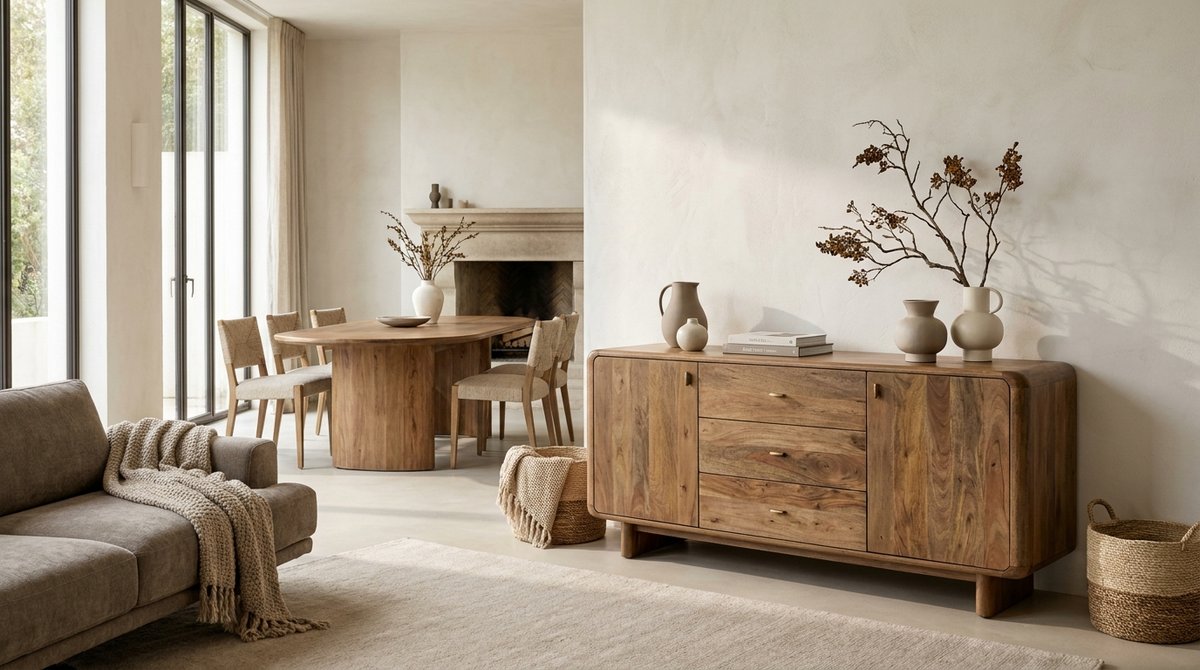
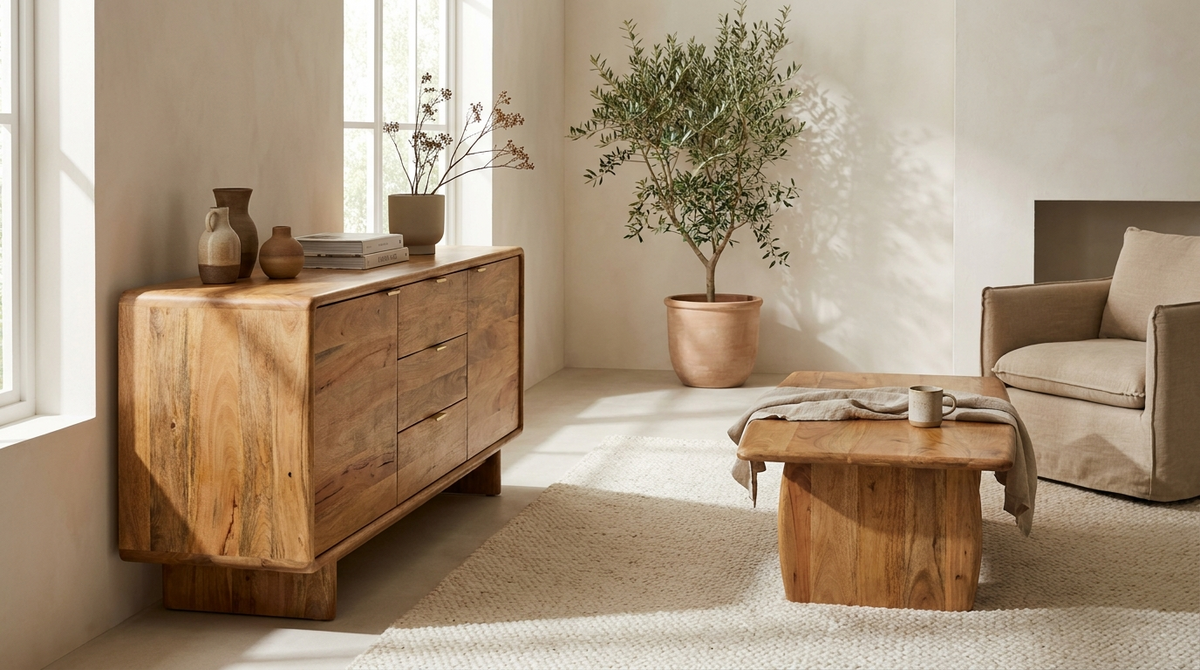
Mango wood's color range runs from golden-brown and honey tones to yellowish hues, frequently interrupted by streaks of pink, dark brown, or near-black. Those darker streaks often come from spalting, a natural process where fungal activity during the tree's life creates color variation in the cellular structure of the wood. The result is grain that looks like no other board in the batch, and no other board in the world. Artisans who work with mango actively select for these patterns; spalting is a feature, not a flaw, provided the wood is properly dried and the spalting hasn't progressed to the point of structural compromise.
Lightly spalted mango wood retains its structural integrity and simply carries more visual character than a clear, uniform board. Heavily spalted wood, where the material starts to feel spongy or punky, isn't suitable for load-bearing applications. A skilled craftsperson knows the difference and selects accordingly.
Why artisan mango furniture looks different from catalog pieces
Factory furniture production typically wants uniform, predictable material. Boards get sorted to minimize variation, and the goal is consistency across a product line. Artisan furniture production works the other way: the craftsperson reads the grain, works with its direction, and lets the material's natural character shape decisions about how a piece is cut, joined, and finished.
That's exactly the approach behind Mercer & Gray's collections. The Orchard collection, in particular, reflects a deliberate decision to let mango wood's agricultural roots and visual richness drive the design rather than constrain it. Each piece carries grain patterns that a photograph can suggest but not fully capture. If you want furniture that looks alive rather than printed, that distinction matters.
Mango wood vs. oak and teak: an honest comparison
Side-by-side hardness and durability
Here's a plain-language look at where mango wood sits relative to the woods most buyers consider:
- Mango wood: 1,070 lbf. Suitable for all indoor furniture applications. Good daily-use durability, natural grain character, requires indoor conditions and proper finishing.
- Oak (red/white): 1,200 to 1,400 lbf. Harder, more traditional aesthetic, well-suited to high-wear surfaces. Significantly more expensive than mango wood.
- Maple: 1,450 to 1,550 lbf. Among the hardest domestic furniture woods. Excellent for high-traffic surfaces. Dense, uniform grain with less visual expressiveness than mango.
- Teak: Approximately 1,000 to 1,150 lbf, but with natural oils that give it strong resistance to moisture, insects, and outdoor conditions. A reliable choice for outdoor furniture. Price reflects that specialized performance.
- Pine: 350 to 600 lbf. A softwood that dents and wears more quickly. Better suited to decorative or low-stress applications than daily-use furniture.
Mango wood and teak occupy similar positions on the Janka scale for indoor use. The practical difference is that teak's natural oil content makes it the right choice for outdoor or high-humidity environments. Inside, the performance gap between the two narrows considerably, and the price gap does not.
The price gap and what it actually buys you
Most mango wood furniture in the US market falls between $500 and $2,000 for standard pieces. Oak furniture at comparable scale typically starts around $1,500, and teak furniture for the same application often runs $2,500 to $10,000 or more. That price gap exists because mango trees grow and complete their agricultural cycle far faster than oak or teak, and because the timber is a byproduct rather than a primary crop.
What you're getting with mango wood at that price point is genuine solid wood construction, real hardwood durability for indoor use, and visual character that more expensive woods often can't match. What you're giving up is the marginal hardness advantage of oak and the outdoor resilience of teak. For home furniture buyers who won't be putting their dining table on the back deck, that's a straightforward trade, and it's a large part of why mango wood is a good choice for solid wood furniture at almost any budget.
The drawbacks worth knowing before you buy
Where mango wood is genuinely vulnerable
Mango wood's high starch content makes it more susceptible to termites, powder post beetles, and fungal growth than lower-starch hardwoods. Left untreated, it can absorb moisture and warp, or dry out and crack in low-humidity environments. It is not suitable for outdoor use; direct sun and moisture exposure will degrade it significantly faster than indoor conditions. In consistently dry or heated interiors, the wood benefits from regular maintenance to prevent surface checking.
These vulnerabilities are real, but they aren't unique to mango wood. Most hardwoods require proper finishing and care. The difference is that mango wood's starch content means the stakes of skipping that care are higher than with, say, white oak. A piece that arrives properly finished and is kept in normal indoor conditions is unlikely to encounter these problems in practice.
How proper finishing changes the equation
A quality factory-applied finish, whether wax, oil, or varnish, forms a protective barrier that significantly reduces moisture absorption and cuts off the food source that attracts insects. Mango wood's fine grain means it actually accepts less finish to achieve a smooth, sealed surface than coarser woods require. That's a practical advantage: the finishing process is relatively straightforward, and the results are consistent when done correctly.
The finishing story doesn't end at purchase, though. Ongoing care is part of owning mango wood furniture. In dry environments or during heated winter months, oil or wax the surface every six to twelve months keeps the wood nourished and prevents surface cracking. In more temperate indoor conditions, once a year is typically sufficient. A simple water-bead test tells you when the wood needs attention: if a small drop of water absorbs quickly rather than beading on the surface, it's time to oil.
What to look for when buying mango wood furniture
Craftsmanship and sourcing signals that matter
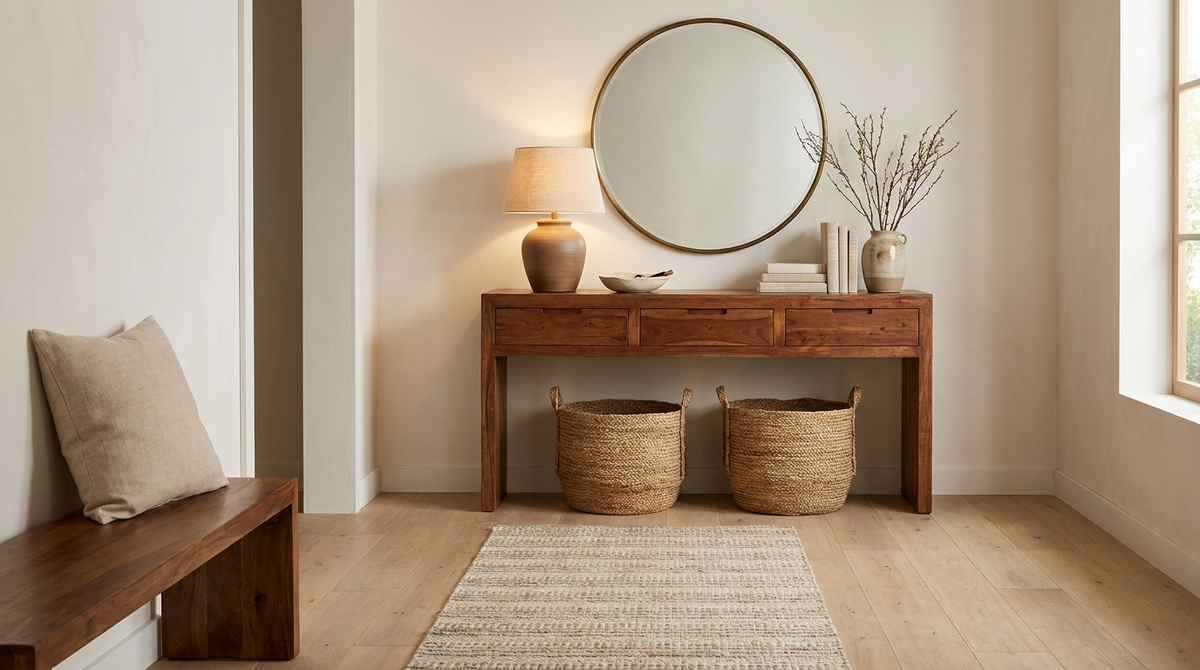
The difference between well-made mango wood furniture and a budget piece that uses the same material label is significant. Look for solid wood construction throughout, not a veneer layer over MDF or particleboard. Check grain continuity across joints, which indicates careful material selection rather than off-cut assembly. Traditional joinery methods, dovetail joints in drawers, mortise-and-tenon in frames, signal that the construction will hold over decades rather than years. Inspect the undersides and back panels of pieces where possible; quality craftsmanship finishes hidden areas neatly, while mass production often leaves them rough.
For guidance on assessing solid wood construction, see our Solid Wood Furniture for Sale: A Buyer's Guide. Ask about the timber source. A brand that can tell you the origin of its wood, whether it's FSC-certified or responsibly harvested through agricultural partnership, is more likely to be transparent about its construction too. Mercer & Gray uses 100% solid mango wood and responsibly sourced timbers, with handcrafted joinery and full finish customization available through a swatch library. That's what mango wood looks like when it's taken seriously as a material rather than used as a low-cost filler.
A simple care routine that extends the lifespan
Mango wood furniture doesn't require complicated maintenance, just consistent attention. Oil or wax the surface every six to twelve months, more frequently in dry climates or during winter when heating systems reduce indoor humidity. Keep pieces away from direct heat sources like radiators and vents, and out of prolonged direct sunlight, which can fade the color over time. Clean with a lightly damp cloth rather than water-heavy solutions, and avoid harsh chemical cleaners that strip the finish.
Coconut oil, mineral oil, and beeswax are all well-suited to mango timber. For food-adjacent surfaces like a kitchen island or sideboard, food-safe mineral oil is a reliable choice. A two-step approach works well: one coat of oil to nourish, followed by a beeswax layer to seal and add sheen. With that routine in place, a quality mango wood piece will look better at fifteen years than it did at one.
The case for mango wood, honestly made
So what makes mango wood a good choice for solid wood furniture? It sits comfortably in hardwood territory, handles daily indoor use without complaint, carries grain patterns that no other wood quite replicates, and arrives at a price point that makes genuine solid wood furniture accessible without requiring an oak or teak budget. That's a combination most hardwoods can't offer all at once.
It has real limits. It's not teak outdoors, and it's not maple in a commercial kitchen. But for the vast majority of home furniture buyers furnishing bedrooms, dining rooms, living spaces, and home offices, those limits simply don't apply. What matters is how the material performs where it's actually used, and mango wood performs well in those conditions when it's properly made and maintained.
If you're ready to see what mango wood looks like in skilled hands, Mercer & Gray's collections are built on exactly this material. Every piece is handcrafted from 100% solid wood, finished with care, and customizable to your space. Browse the collections and judge for yourself.