Where Can I Get Solid Wood Furniture Without Being Misled? A Practical UK Buying Guide
If you’ve been asking yourself “where can I get solid wood furniture” and actually trust what you’re buying, you’re not alone. A lot of “wood” furniture online is really veneer over MDF or particleboard, and listings can be frustratingly vague. The result is predictable: tables that chip at the edges, feel hollow, wobble over time, or simply don’t have that warm, substantial feel you wanted.
The good news is there are straightforward ways to shop with confidence. Below is a practical guide to where to look, what to check, and the questions that quickly separate genuine solid wood pieces from convincing lookalikes—especially if you’re buying something central like a dining table.
Why it’s so hard to buy “real wood” furniture online
Retailers aren’t always lying; it’s often the language that’s slippery. “Wood effect”, “wood finish”, “engineered wood”, “real wood veneer” and “solid wood frame” can all sound reassuring while the main surfaces are still MDF or particleboard.
A common scenario: a dining table is described as “oak finish” with “solid wood legs”. That may mean only the legs are solid, while the tabletop—the part that takes daily wear—is a veneered board. Veneer isn’t automatically bad, but it isn’t the same as a solid wood top you can live with for years.
If you’re overwhelmed by huge retailers, marketplaces, and thousands of similar listings, you’re not doing anything wrong. You simply need a repeatable checklist and a few dependable places to search.
Where can i get solid wood furniture? Start with these retailer types
If your priority is a dining table that feels substantial and lasts, these are the most reliable routes—each with pros and trade-offs.
1) Specialist solid wood furniture retailers
These are brands whose core range is real wood furniture rather than an occasional “wood” line. They’re more likely to disclose materials properly, show detailed photos, and talk about joinery and finishes. This is where many people end up after being disappointed by flat-pack pieces.
2) Independent makers and workshops
If you enjoy the idea of handcrafted furniture, smaller workshops can be a great option. Ask clear questions about timber thickness, construction and finish. The downside can be longer lead times and less standardisation (which may or may not matter to you).
3) Showrooms and local furniture shops
Seeing a table in person can be invaluable: you can feel the weight, check the edge profile, and inspect the grain. Many local shops also have relationships with makers.
4) Vetted online-only brands
Some online retailers do an excellent job with transparency and product photography. Look for detailed specifications and close-ups of corners, edges and grain.
5) Marketplaces (with caution)
You can find gems, but marketplaces are where vague listings thrive. If you shop there, assume nothing and verify everything (more on exactly how below).
If you’re specifically searching for solid wood furniture retailers, focus on those that clearly state “solid wood” for the main surfaces, not just the legs or frame.
A quick checklist to confirm it’s truly solid wood (not veneer or MDF)
Use this checklist before you buy—especially for dining tables, where the top gets the most use.
Look for:
• “Solid wood” stated for the tabletop
This should be explicit. If the listing only says “solid wood legs” or “solid wood frame”, treat the top as suspect until proven otherwise.
• Material details that go beyond the headline
A trustworthy description usually specifies the wood species (for example, mango wood), and explains how it’s finished.
• Thickness and construction notes
Solid wood tables often mention top thickness or how the top is built (for example, planked construction). If there’s no detail at all, ask.
• Close-up photography
You want edge shots, corner shots and detail images that show grain and join lines. If every photo is from far away with heavy styling, it’s harder to verify what you’re getting.
• Honest wording around natural variation
Real wood has grain movement and tonal variation. Good retailers don’t pretend every piece looks identical; they help you understand what varies and what won’t.
Red flags:
• “Wood effect”, “oak look”, “wood finish” with no mention of solid wood
• “Engineered wood” with a “real wood veneer” top
• “Easy-clean, scratch-proof” promises without explaining the finish
• A suspiciously lightweight product for its size (often a sign of board construction)
If you’re unsure where to get real wood furniture, start by applying this checklist to any listing you’re considering—it will quickly narrow the field.
The three questions to ask any retailer before you buy
Whether you’re shopping a big name, a marketplace seller, or a specialist brand, these questions cut through the confusion.
1) Is the tabletop 100% solid wood all the way through?
Ask specifically about the main surface. A retailer who sells real solid wood furniture will answer clearly.
2) What is the core material under the surface?
If it’s veneer, ask what it’s veneered onto (plywood, MDF, particleboard). This matters for durability and repairability.
3) How is it joined and finished?
You don’t need a lecture on woodworking—just enough to understand how the table is built and protected. A sensible, practical finish should suit real life: wiping spills, daily use, the occasional hot mug (with a coaster, ideally).
If replies are vague, defensive, or ignore your question, take that as useful information. Good retailers are usually happy to explain because clarity builds trust.
Choosing a solid wood dining table that suits real life (not just a photo)
A dining table is one of the hardest-working pieces in a home. The right one should feel good on an ordinary Tuesday as well as when you’ve got friends over.
Think about your day-to-day:
• Family meals and homework
If your table will double as a homework station, look for a surface that feels robust and a size that gives everyone elbow room.
• Small-space living
In a flat or terrace dining area, pay attention to leg placement. A table can look generous in photos but feel cramped if the legs steal chair space.
• Open-plan rooms
A solid wood table can anchor an open-plan kitchen/diner with warmth and texture. Natural grain helps a space feel layered and lived-in, especially alongside simple cabinetry.
• Hosting
If you regularly seat guests, consider how the table ends meet legs—will someone end up straddling a leg at the head? Practical comfort matters as much as style.
A note on mango wood:
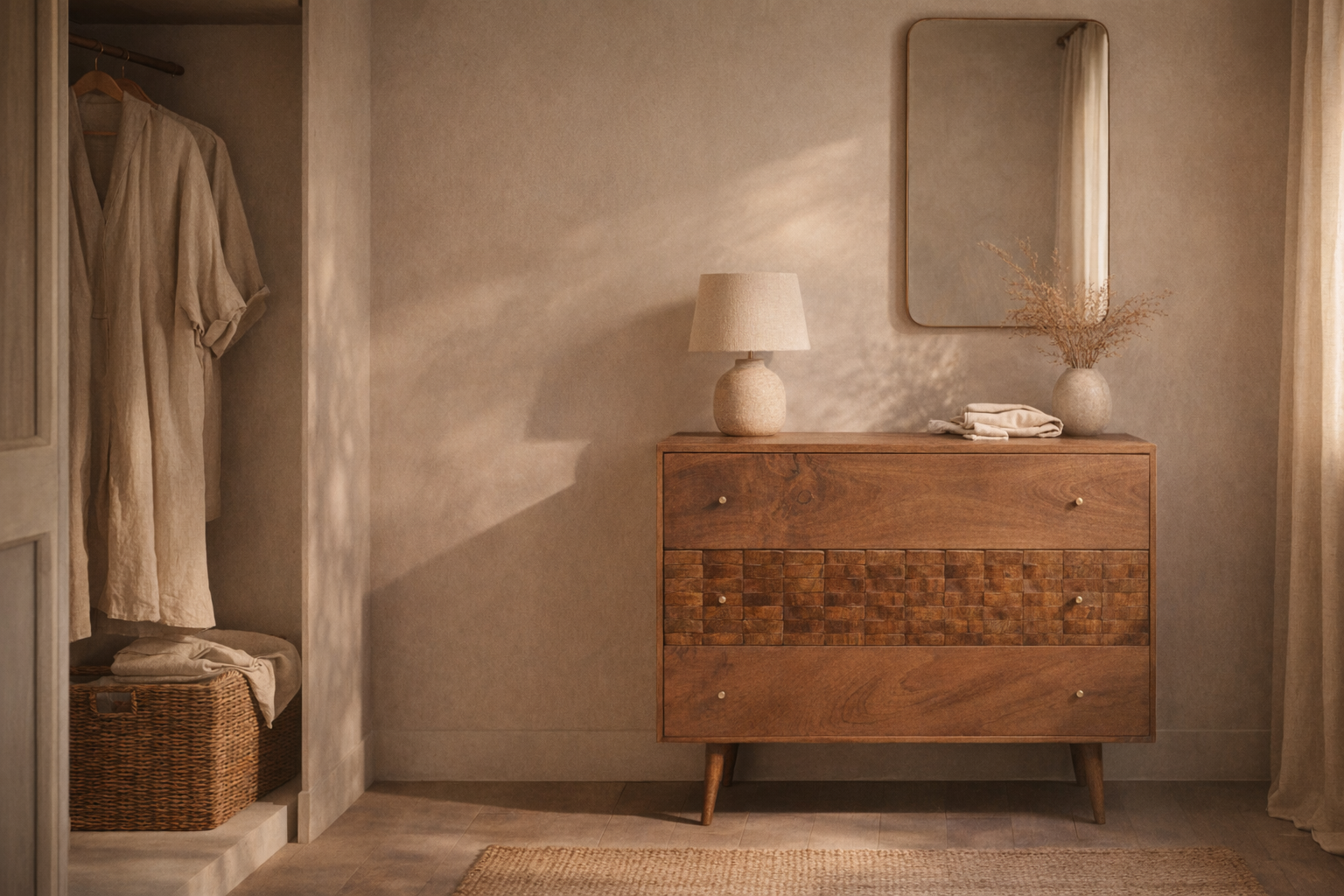
Solid mango wood is popular for good reason. It has a naturally expressive grain, a warm tone that suits mid-century modern, Scandinavian, Japandi and rustic modern interiors, and it holds up well in busy homes when properly finished. If you like character without a fussy look, it’s a strong choice for dining tables.
How to spot quality craftsmanship (the bits you’ll appreciate in five years)
Even within “solid wood” furniture, build quality varies. Here’s what tends to separate a long-term piece from a short-term one.
• Stable, considered proportions
A well-made dining table feels balanced: not top-heavy, not spindly. It shouldn’t rack (twist) when you lean on it.
• Thoughtful edges and corners
Look at the edge profile in photos. A nicely finished edge feels better under your hands and resists looking shabby after knocks and bumps.
• Consistent finish application
A good finish looks even, not patchy or overly glossy. It should enhance the grain rather than smother it.
• Sensible detailing rather than gimmicks
Handcrafted doesn’t need to shout. Small details—clean lines, tidy joins, a pleasing grain layout—are the things that quietly elevate a room.
Real-world example:
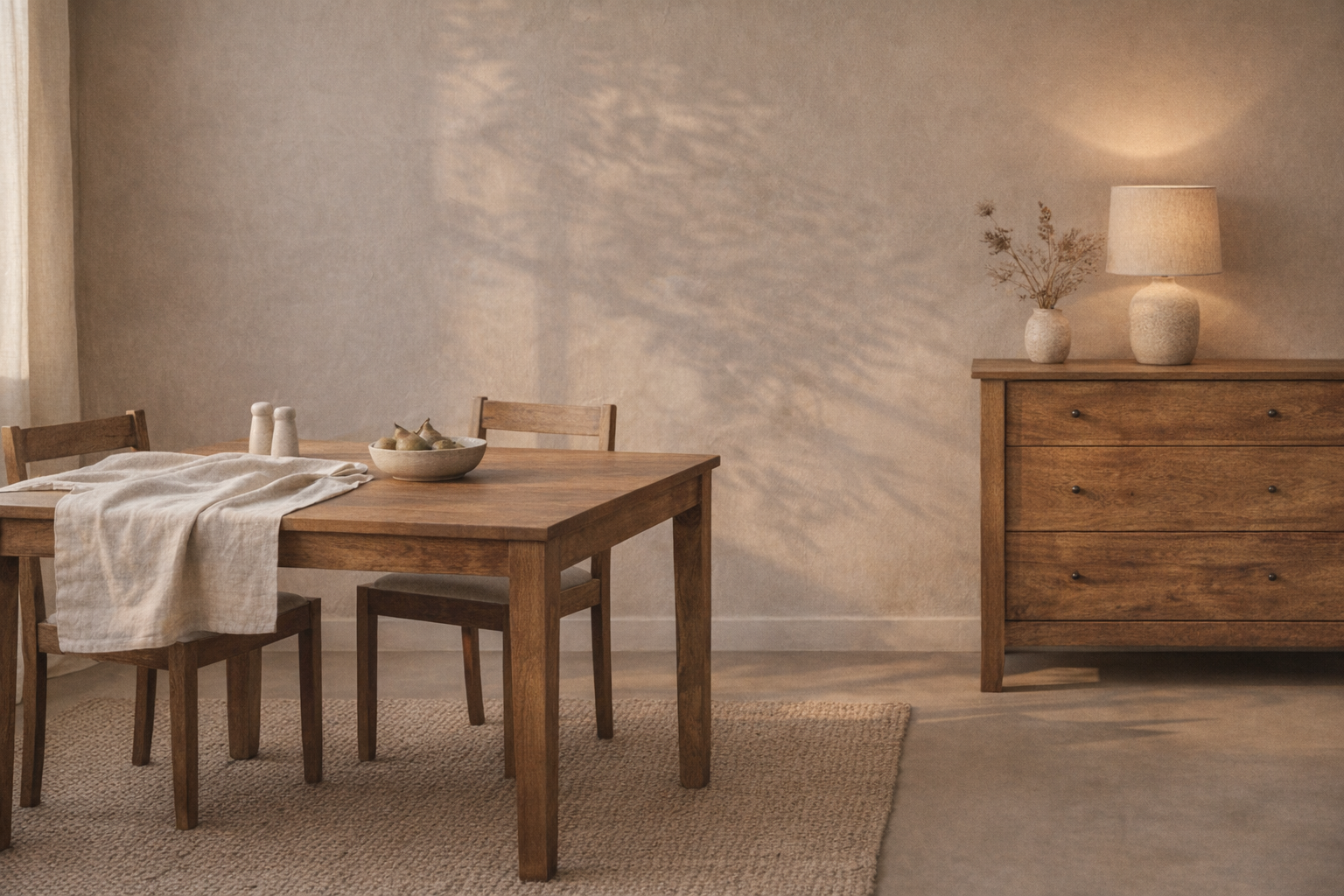
If you’re building a “grown-up” dining space—say, a warm neutral room with linen curtains, a textured rug and simple ceramic lighting—a solid wood dining table becomes the grounding piece. Pair it with upholstered or wooden dining chairs and it feels intentional, not like a placeholder you’ll replace in two years.
A simple, low-stress way to shop online with confidence
If you’re buying online, here’s a process that works without turning your evenings into a research project:
1) Shortlist 3–5 tables you genuinely like
Ignore the noise. Start with design, size and layout.
2) Verify materials using the checklist
Confirm the tabletop material first. If it’s not solid wood (and you want it to be), move on.
3) Check the photos like you’re inspecting it in person
Zoom in on edges, corners, legs and the underside if shown.
4) Ask the three questions
The quality of the reply is part of the product.
5) Match it to your lifestyle
Kids, pets, hosting, open-plan living—choose a finish and shape that suits how you actually live.
If you’ve been wondering where can I get solid wood furniture and feel confident it’s the real thing, the answer is: shop with retailers who are specific about materials, show clear details, and can explain construction without hedging.
Conclusion
Feeling unsure about where can I get solid wood furniture is completely understandable—so many listings are designed to sound “wooden” without being solid wood where it counts. Once you know what to look for (clear material wording, solid wood tabletops, honest photography, and straightforward answers), buying a dining table becomes much simpler and far more satisfying.
If you’re ready to focus your search on warm, characterful pieces made to be lived with, explore our handcrafted solid mango wood furniture collection at Mercer and Gray—starting with our dining tables, and building out your space from there.