Entryway Furniture Ideas for a Warm Earthy Aesthetic
Your entryway is the first room you walk into every day and the last one you leave. Most people style it for guests and forget it exists the rest of the time. That's worth questioning.
If you're exploring entryway furniture ideas with a warm earthy aesthetic, the appeal goes deeper than looks. Natural wood tones, terracotta accents, woven textures, and unpolished surfaces are material choices as much as decorative ones. They hold up and age well, and they signal something quieter and more grounding than a white-painted console with chrome pulls.
At Mercer & Gray, we work almost exclusively with solid handcrafted mango wood to build exactly this kind of furniture, pieces that feel earned rather than assembled. By the end of this article, you'll know which furniture to choose, how to build the color palette, and how to lay everything out for the size of space you actually have.
Why Earthy Aesthetics Are the Right Tone for an Entryway
The entryway has a psychological job that most people overlook. The first room you step into sets the emotional register for the entire home. Warm tones and natural materials reduce visual noise immediately. They tell your nervous system that the outside world has been left at the door, which is precisely what you need from a threshold space.
Most entryways get styled for guests. The ones that actually work are styled for the person who lives there. That's the soft contrarian take worth sitting with: your entryway is not a lobby. It's a decompression chamber, and earthy entryway furniture is built for that purpose.
Earthy design is not the same as rustic or bohemian. Rustic can feel heavy and overwrought. Bohemian can feel busy, layered to the point of anxiety. Earthy is intentional restraint with warmth. Think warm neutrals like cream, linen, and sand alongside natural wood tones, terracotta and clay accents, woven organic textures, and surfaces that show the hand that made them. It's a vocabulary of materials, not a mood board.
Organic materials don't date because they were never tied to a moment. A mango wood console table looks as considered in ten years as it does the day it arrives. That's the investment mindset worth building before you start shopping, and it's one reason so many people find that warm earthy entryway furniture ideas age far better than trend-driven alternatives.
The Color Palette That Makes It All Click
The 60-30-10 rule is the most useful framework for layering earthy colors in a foyer. Sixty percent of the palette lives on your walls. Thirty percent lives in your furniture and textiles. Ten percent lives in your hardware, lighting, and small accessories. Follow that proportion and the space almost styles itself. For a practical explanation of the 60-30-10 approach, see the 60-30-10 color rule.
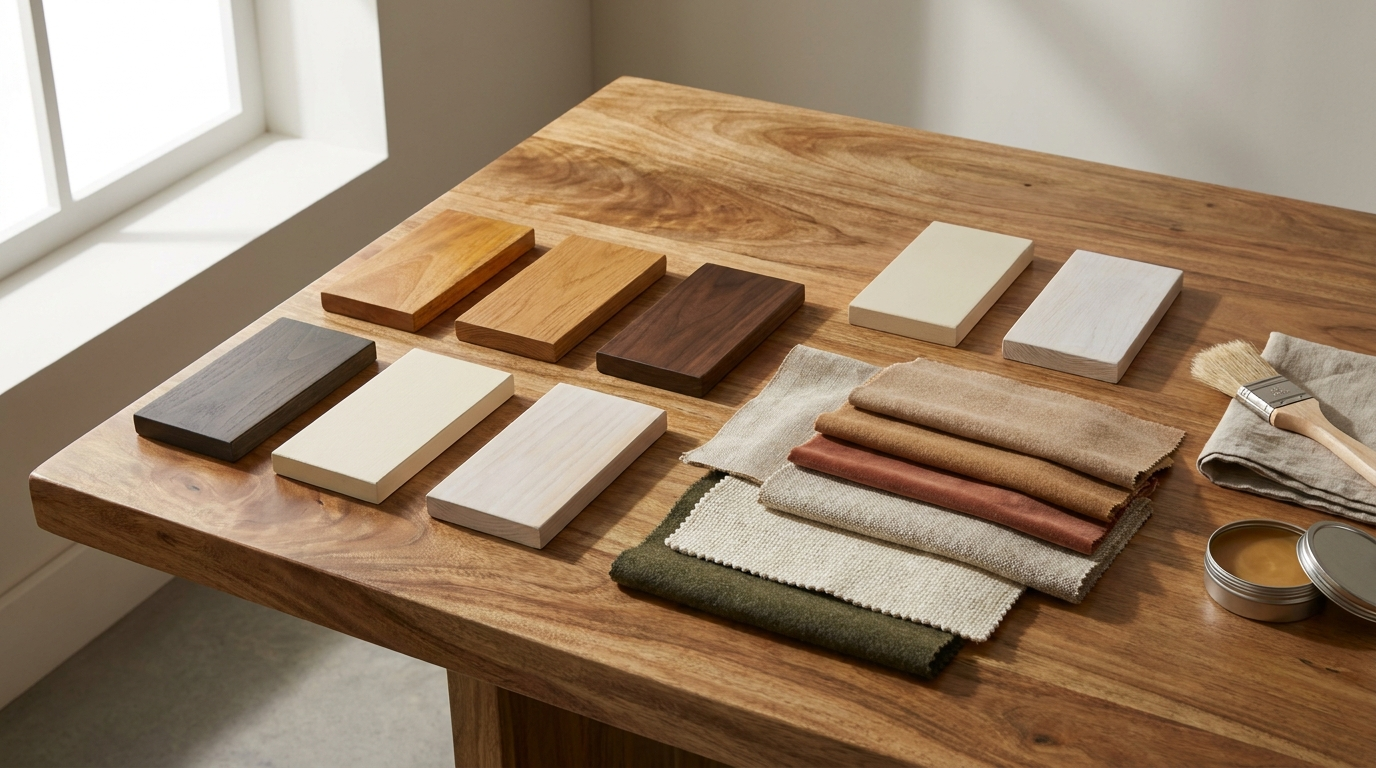
Walls should carry the lightest shades. Warm whites, linen creams, and soft greiges keep a small entryway feeling open while allowing warmer tones to do the expressive work elsewhere. The Clay and Cream palette (hex codes around #E7D8C9 through #C8A07A) is a reliable starting point. Sherwin-Williams Cavern Clay (SW 7701) and Accessible Beige (SW 7036) are two of the most practical options in 2026. The first creates a glowing terracotta statement wall; the second is a warmer, more flexible neutral that pairs with almost any wood tone. You can also review broader seasonal palettes like the Behr 2026 palette for additional inspiration.
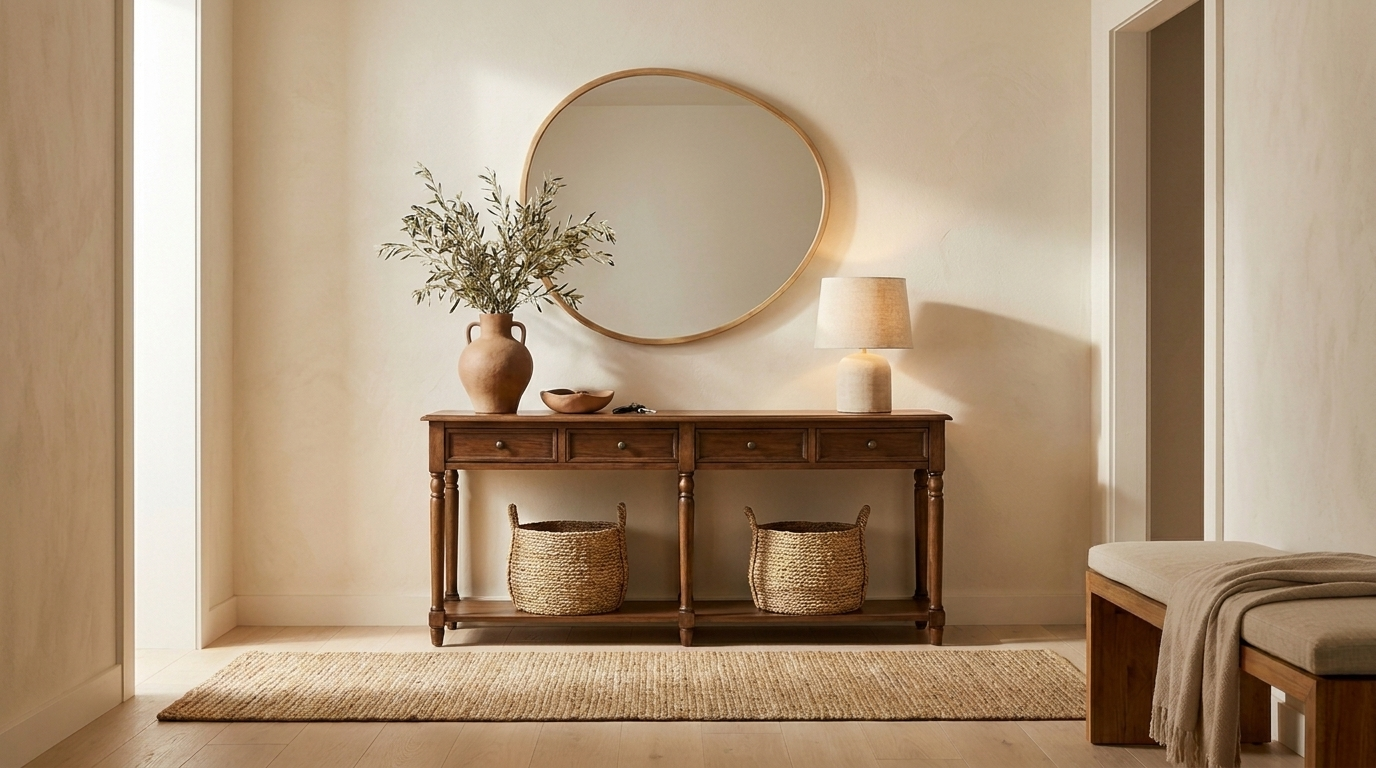
Furniture and rugs carry the thirty percent and do most of the warmth-building work. A mid-tone console table in natural mango wood, paired with a woven jute runner and a terracotta-toned bench cushion, creates layered depth that feels considered rather than random. Texture variation matters as much as color here. The same warm brown reads differently in wood, linen, and rattan, and that difference is what makes the palette feel rich rather than flat.
The final ten percent should carry your deepest tones: espresso, deep olive-black, or dark bronze. These anchor the lighter palette and add the visual edge that keeps everything from reading too soft. Swapping brushed chrome hooks for matte black or oil-rubbed bronze is the single fastest change you can make to push an entryway into earthy territory.
Entryway Furniture Ideas for a Warm Earthy Aesthetic: The Pieces That Do the Heavy Lifting
The console table is the keystone piece of any entryway. In a warm earthy aesthetic, it needs to carry the warmth of natural grain and honest material. Look for solid wood construction rather than veneer, a warm natural finish, and a clean organic silhouette without ornate flourishes. Handcrafted pieces work better here than factory-finished ones because the slight variation in grain and finish adds exactly the lived-in character that earthy styling depends on.
Mercer & Gray's mango wood console tables are built for this role. The natural honey tones of the mango grain pair directly with terracotta accents and woven textures, and because each piece is handcrafted, the grain and finish vary slightly from table to table, which is the point. Mango wood is also well-suited to high-traffic entryways, with a Janka hardness rating around 1,120 lbf. That's somewhat lower than red oak (approximately 1,290 lbf) but still solid and durable, well above many softwoods sold as "quality" at mass-market price points. Note that mango wood performs best with a proper protective finish; without one, it can be susceptible to moisture and surface cracking over time. Read more about our approach in Solid Wood Furniture for Kitchen Life | Mercer and Gray.
A bench at seated height anchors the space and provides real function: a place to pull off shoes, drop a bag, set a jacket. For earthy entryway furniture, solid wood legs with a woven, linen, or natural leather seat are the right call. If you prefer a fully organic look, overstuffed benches in synthetic upholstery tend to interrupt the natural palette and may not hold up as well under constant daily use. Mercer & Gray's entryway bench options are proportioned to pair naturally with their console tables, which means you're not hunting for pieces that approximate each other.
Storage pieces that stay true to the aesthetic include woven baskets, open wooden cubbies, and narrow shoe cabinets in warm wood finishes. High-gloss shoe racks and white MDF cabinets interrupt the palette and tend to look cheap within a year. One practical note on sizing: baskets and storage should be proportional to your console, not competing with it for visual weight. One or two baskets beneath the console surface is usually enough to handle daily clutter without overwhelming the arrangement.
Natural Materials and Textures That Complete the Look
Each core material in an earthy entryway contributes something distinct. Solid mango or oak brings warmth and durability. Rattan and wicker add lightness and organic texture without visual weight. Jute and seagrass work underfoot in rugs and baskets, adding the tactile quality that makes natural materials feel genuine rather than merely decorative.
For rugs in a high-traffic entryway, seagrass is the most practical natural-fiber choice. It's among the most stain-resistant options available, handles heavy foot traffic without losing integrity, and pairs well with warm wood tones. Sisal works if you choose a thin pile or a treated variety. Jute is soft and appealing, but it breaks down under constant heavy traffic and is better suited to lower-impact rooms.
Terracotta planters are one of the most affordable and impactful earthy accents you can add. One or two small terracotta pots with trailing greenery or dried botanicals on the console can transform the space without a significant investment. A common styling approach is to use odd-numbered groupings, vary the heights, and place them on a wooden tray to ground the arrangement. Terracotta wall art or clay-toned ceramics serve the same function if you prefer the surface to stay clear.
A practical guideline for layering materials in a small space: limit yourself to three or four different textures. In an entryway, that usually means the wood grain of the console, a woven basket or bench seat, a natural fiber rug underfoot, and one terracotta or ceramic accent. Everything else should be restrained. The editing is as important as the choosing. If you're considering mixing finishes and intentionally mismatching elements, take a look at Mismatch Bedroom Furniture: A Stylish Guide for guidance on making varied pieces read cohesive.
Laying Out Your Earthy Entryway for Your Space Size
For entryways under four feet wide, depth is everything. A console table no deeper than twelve to fourteen inches keeps the path clear without sacrificing surface. Wall-mounted hooks placed at sixty-six to seventy inches from the floor prevent coat clutter at eye level. Use demilune or slim console shapes rather than cabinets, and keep one small basket under the console for shoe storage. Mercer & Gray's slimmer mango wood consoles are proportioned for exactly this kind of space, giving you solid wood quality without sacrificing clearance. For reference on recommended console sizes and clearances, consult typical console table dimensions.
A medium-sized entryway, roughly five to eight feet wide, supports a full console table, a bench along one wall, and defined micro-zones: shoe drop, key landing, outerwear hooks, and a grab-and-go basket. Add a lower row of hooks at forty-two to forty-eight inches if there are children in the household. Align each zone with natural movement patterns rather than spacing things evenly for symmetry's sake. This is where the console-and-bench pairing from Mercer & Gray works best as a cohesive warm earthy entryway setup. For tips on arranging pieces and defining circulation, see How to Place Furniture in a Living Room | Mercer and Gray.
A wide entryway, eight feet or more, allows for a more expressive version of the earthy aesthetic. A longer console, dual benches or a bench with an ottoman, a statement mirror, and more layered styling on the console surface all become viable. Anchor the zone with a large natural fiber rug so the furniture doesn't feel pushed to the edges of an empty room, and balance visual weight across the longer wall rather than treating it as a continuous display shelf.
The Finishing Details That Feel Lived-In
A table lamp with a warm bulb on the console creates immediate coziness the moment you open the door. A wall sconce above it extends that warmth upward and doubles the functional lighting without adding floor clutter. Mirrors in an earthy entryway should have a natural wood frame or a simple curved edge; ornate gilding pulls the aesthetic in a different direction entirely.
A few well-placed plants do more for the space than most decorative accessories. Low-maintenance options like trailing pothos, snake plants, or dried pampas in a terracotta pot work well because they need very little light and ask almost nothing of you. Dried botanicals in a wooden or clay vase add organic texture without requiring any care at all. The guideline is restraint: one or two living plants rather than a collection that overwhelms the entryway's clean intention.
On budget decisions: spend where it counts. The console table and bench are the pieces you see every day. Quality solid wood pieces in the $600 to $1,000-plus range for hero items are worth the investment. Save on accents. Terracotta planters, jute baskets, and natural fiber runners are all available at accessible price points, roughly $40 to $300, without compromising the overall look. It's intentional spending in the right direction.
A Space That Earns Its Place
Warm earthy entryway furniture ideas aren't a trend to adopt or a Pinterest board to replicate. They're a set of material decisions that add up slowly and hold up well. The mango wood console table. The woven basket. The terracotta pot with something growing in it on the corner of the shelf. Each one is a small choice that says something about how you want to live. For inspiration on creating a modern organic threshold, consider exploring ideas for creating a modern organic entryway.
The earthy foyer aesthetic works because it's built from things that age with you rather than against you. Solid wood develops a better patina over time. Natural fiber gains character. Terracotta weathers in a way that looks intentional rather than worn out. These are materials that belong to the long game.
What does the entryway of a home say about the rest of it? Probably more than we give it credit for. It might be worth treating it less like an afterthought and more like the first sentence of something worth reading.