The Best Coffee Table Shapes for Every Living Room Layout
The Best Coffee Table Shapes for Different Living Room Layouts
A coffee table can make a living room feel balanced and comfortable or interrupt movement and make the seating arrangement seem undersized. The best coffee table shapes for different living room layouts are determined less by trend than by the geometry of the room, the position of the seating, and the way your household uses the space.
Start with the furniture you already have. A long sofa often benefits from a rectangular table, while a compact conversation area may feel more natural with a round or oval design. Sectionals can accommodate square, round, oval, or rectangular tables depending on the chaise, inside corner, and available walking space. Before choosing a finish or material, use the guide below to find the shape that supports proportion, access, and everyday flow.
Start With the Layout, Not the Table
Begin by identifying the main seating arrangement. Is the room built around one sofa and two chairs, an L-shaped sectional, two facing sofas, or a smaller loveseat-and-chair grouping? In an open-plan home, consider the living area as its own zone rather than measuring it as part of the entire room.
Note the location of doors, hallways, fireplace hearths, windows, media consoles, and the routes people use most often. A coffee table should support the room’s focal point without forcing people to walk around it awkwardly.
A table that looks attractive in a showroom may not be the right choice for your home. A shape that echoes the room’s lines can create visual order, while a contrasting curve may soften a space filled with corners. The right decision is the one that leaves the seating area easy to use and proportionate from the viewpoints that matter most.
The Best Coffee Table Shape for Different Living Room Layouts
Long Sofa in a Rectangular Room
A rectangular coffee table is often a natural choice for a long sofa and an elongated living room. Its length can echo the sofa, while its broad surface gives several people access to drinks, books, games, and serving pieces.
This shape also works well when the sofa faces a television, fireplace, or media console. The table establishes a clear directional axis between the seating and focal point. Choose a footprint substantial enough to relate to the sofa, but not so deep that it narrows the passage around the seating group.
Small or Narrow Living Room
Round and oval tables can make circulation feel less interrupted in a compact room because they eliminate sharp corners along a walking route. An oval table offers some of the length and surface area of a rectangular table while keeping a softer outline.
A slim rectangular table may be better in a very narrow room, particularly when the sofa faces a media console and the furniture needs to follow a clear front-to-back axis. Nesting tables are another option when you want to separate the surfaces for entertaining and tuck them away when floor space matters.
A round table is not automatically smaller. Compare its actual diameter with the available space, including the clearance needed between the table and surrounding seating.
L-Shaped or Sectional Sofa
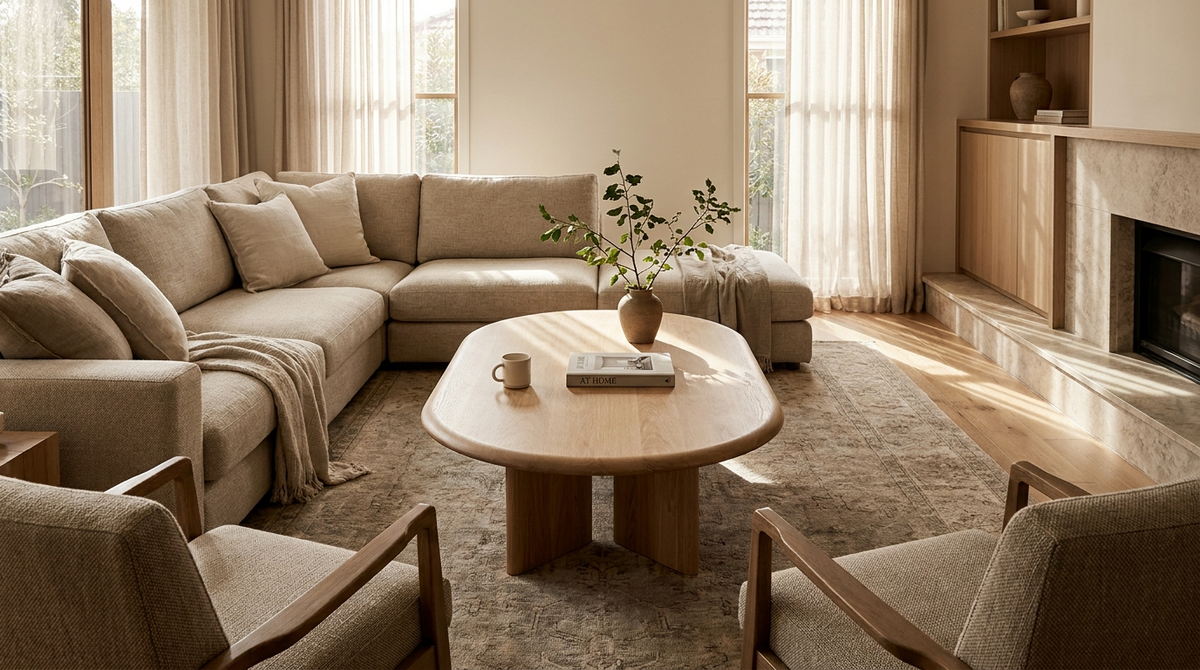
Sectionals offer several possibilities because the coffee table needs to serve more than one seating position. A square table can sit naturally within the inside corner of a standard L-shaped sectional, creating a centered surface for the group.
Round or oval tables may be preferable when the room is tighter or the chaise creates a busy visual edge. Their curved outline can make movement around the arrangement feel less constrained. A rectangular table may suit a larger sectional when it runs parallel to the longest side and leaves a clear route past the chaise.
The shape should follow the usable area in front of the sectional, not simply the longest sofa segment. Consider the inside corner, chaise, and nearby route as one footprint when comparing options.
Two Facing Sofas or a Formal Conversation Area
Two facing sofas usually work well with a rectangular or square coffee table because both sides can reach the center surface. A rectangular table reinforces the length of the arrangement, while a square version creates a more evenly balanced composition.
For a formal room with two chairs and a sofa, consider how many seats need access. A round table can support a centered conversation grouping, especially when the chairs are angled toward one another rather than arranged in straight lines.
Open-Plan Living Room
In an open-plan home, a larger rectangular or square coffee table can help define the living area without walls. Place it centrally within the seating group and use the sofa, rug, lighting, and side tables to reinforce the zone.
The table should clarify the living room’s boundaries rather than obstruct the route between the kitchen, dining area, and entry. If the room has generous dimensions but the seating is relatively light, scale the table to the furniture around it rather than to the entire floor area.
Small Conversation Grouping with Chairs or a Loveseat
A round table is useful for a compact grouping of chairs, a loveseat, or a small sofa with occasional seating. Its equal reach from multiple positions makes the arrangement feel social and centered rather than oriented toward one dominant seat.
An upholstered ottoman can serve a similar role while providing a place to rest your feet. If you need a firm surface, pair it with a tray sized to the ottoman, leaving enough open area for everyday use.
Irregular or Eclectic Layouts
An oval, freeform, or nesting arrangement can keep an eclectic room from feeling overly rigid. This may be useful when the seating does not form a perfect rectangle or when a standard geometric table would conflict with an angled chair, bay window, or unusual architectural feature.
In an irregular room, use the table to create a calm center. It does not need to match every piece exactly; coordination through scale, finish, or material is often more successful than assembling an identical furniture set.
How to Choose the Right Coffee Table Size for Your Living Room
Shape determines how a table fits the room, but size determines whether it is comfortable to use. A practical starting point is a table approximately one-half to two-thirds the length of the sofa. The two-thirds guideline is a proportion aid, not a requirement. A smaller table may be sensible in a tight room, while a deeper sectional may call for more surface area.
For a sectional, measure the usable seating footprint rather than relying only on the full length of the sofa. Consider the inside corner, chaise, recliner mechanisms, and seats people use most often. The table should serve the arrangement without blocking the chaise exit or crowding a nearby passage.
Depth deserves as much attention as length. Leave room for knees and feet, and check whether the table will interfere with a drawer, cabinet door, ottoman, or recliner. A visually narrow table can be more successful than a deep one if the room’s main traffic path runs alongside the seating.
For height, aim for a tabletop approximately level with the sofa seat or slightly lower. Guidance varies, so measure the actual height of your sofa cushions rather than relying on a standard table dimension. This keeps drinks, books, and devices within easy reach without making the table feel taller than the seating.
Between the coffee table and sofa or other seating, begin with approximately 14 to 18 inches of clearance. Adjust that range for legroom, household needs, drawer access, and the need to preserve a clear route. You may need more space where the table sits beside a frequently used doorway or hallway.
Before shopping, mark the proposed footprint on the floor with painter’s tape, newspaper, or cardboard. Sit in each seat, walk around the arrangement, check sightlines, and open nearby doors. This simple test often reveals a scale problem that product photography cannot show.
Round vs. Rectangular Coffee Tables for Small Living Rooms
The choice between round and rectangular coffee tables for small living rooms depends on the room’s proportions and the furniture’s direction not on a rule that one shape always saves space.
A round table is a strong option when several walking paths meet near the seating area or when the room contains many straight edges. The lack of corners can make movement feel more fluid, and a round surface works well at the center of a small conversation group. Its softer outline can also balance a boxy sofa, square rug, or built-in cabinetry.
A rectangular table is often more useful when the room is long and narrow, the sofa is extended, or the seating faces a media console. It provides a defined directional axis and may offer more usable surface area within the same arrangement. A small rectangular table can also align neatly with the rug and sofa while leaving a predictable route along one side.
An oval table sits between the two. It preserves some length for serving and shared access, but its rounded ends are less visually abrupt than a rectangle’s corners. This can be effective in a narrow room that needs a longer table but cannot comfortably accommodate sharp corners.
Consider visual weight as well as footprint. Open legs, a slim profile, a lighter finish, or a less enclosed base can make a table feel less bulky. These qualities do not replace accurate measurements, and the best material depends on your household, the table’s construction, and the manufacturer’s care instructions.
Coffee Table Placement Ideas for Sectional Sofas
Sectionals are generous and comfortable, but their shape can make coffee table placement difficult. Start by centering the table in front of the main seating and orienting it toward the room’s focal point. This works when the sectional faces a fireplace or media console and the table can be reached from multiple seats.
A square table can align naturally within the L of a standard sectional, provided it does not extend too close to the chaise or restrict movement around the outside of the sofa. A round or oval table can soften the corner when the room is tight or the chaise creates a prominent visual edge. For a larger sectional, place a rectangular table parallel to the longest side when you need a continuous surface for the main seating, keeping it clear of the chaise exit.
Nesting tables provide flexibility when surface needs change. Keep them separated for entertaining, then stack or tuck them together during everyday use. An ottoman coffee table is another option when foot comfort, flexible seating, or a softer family-room atmosphere matters more than a hard tabletop.
Choose a Shape That Supports How You Live
Your daily habits should influence the purchase as much as the room’s geometry. If the table regularly holds snacks, laptops, games, and books, prioritize an accessible surface with enough room for more than one person. If the living room is mainly used for conversation, a smaller centered table may be sufficient.
Storage can reduce clutter, but drawers, shelves, lift tops, and baskets may also add visual or physical bulk. Choose those features only if they solve a real problem in the room. A table without built-in storage may be the better fit when nearby cabinets or sideboards already handle those needs.
Children, pets, frequent hosting, and feet-up lounging may point toward rounded edges or an upholstered ottoman as a design consideration. These choices should complement sensible furniture placement and broader household safety practices; no shape is a substitute for supervision or an appropriately arranged room.
Wood, metal, glass, stone, and upholstery each have different care requirements. Follow the manufacturer’s instructions for cleaning, moisture, heat, and everyday use rather than assuming one material performs the same way in every home.
Finally, measure the route into your house. Check doorways, hallways, elevators, stair turns, and tight corners before ordering a large or heavy table.
Common Coffee Table Placement Mistakes to Avoid
The most common mistake is choosing a table before measuring the seating footprint and circulation paths. A table can be attractive yet still feel wrong if its depth crowds the sofa or its corners interrupt the route to the kitchen.
Other problems include:
- Choosing a table that is too small for a large sofa or sectional.
- Focusing on length while overlooking depth and legroom.
- Leaving too little clearance for knees, drawers, doors, or a chaise.
- Placing the table where it blocks a frequently used passage.
- Pushing every piece against the walls instead of creating a connected conversation zone.
- Styling the surface so heavily that there is no room for everyday use.
- Following a design rule even though the household uses the room differently.
If a proportion guideline conflicts with comfortable movement, prioritize the layout and adjust the shape or scale.
A Simple Pre-Purchase Checklist
Before ordering, take a few minutes to confirm the following:
- Measure the sofa or sectional, including the usable seating area.
- Record the sofa seat height and compare it with the prospective tabletop.
- Mark the table’s full footprint on the floor.
- Begin with approximately 14 to 18 inches between the table and seating, then adjust for comfort and traffic.
- Check the chaise exit, recliners, doors, drawers, and nearby walkways.
- Decide whether round, oval, square, or rectangular geometry best supports the room’s focal point.
- Compare dimensions, tabletop height, materials, storage features, care requirements, and delivery specifications across products.
- Measure the delivery route before purchasing.
The Bottom Line
The best coffee table shape for your living room is the one that creates proportion, access, and flow for that specific space. Round or oval tables are often comfortable in tighter arrangements, rectangular tables suit long sofas and directional layouts, and square tables can work well with some sectionals and centered seating groups. Those are useful defaults, not fixed rules.
Measure first, test the footprint, and choose the table that helps the entire seating area work better not simply the one that looks appealing on its own. When you're ready to compare options, explore Mercer & Gray's coffee table collection for shapes, sizes, and finishes suited to different living room layouts.
```