Round vs. Rectangular Coffee Tables: Which Is Right for Your Room?
Round vs. Rectangular Coffee Tables: Which Shape Works Best?
A living room can feel awkward for a surprisingly simple reason: the coffee table is too long, too small, too close to the sofa, or poorly matched to the room’s traffic pattern. So, round vs. rectangular coffee tables: which is right for your room? Choose rectangular when you need linear reach and strong alignment with a sofa. Choose round when you want softer circulation or a more central conversation area. In either case, measurements should confirm the decision before you buy.
The right shape depends on your seating arrangement, room proportions, walking paths, and the way you use the space every day.
Round vs. Rectangular Coffee Tables: The Short Answer
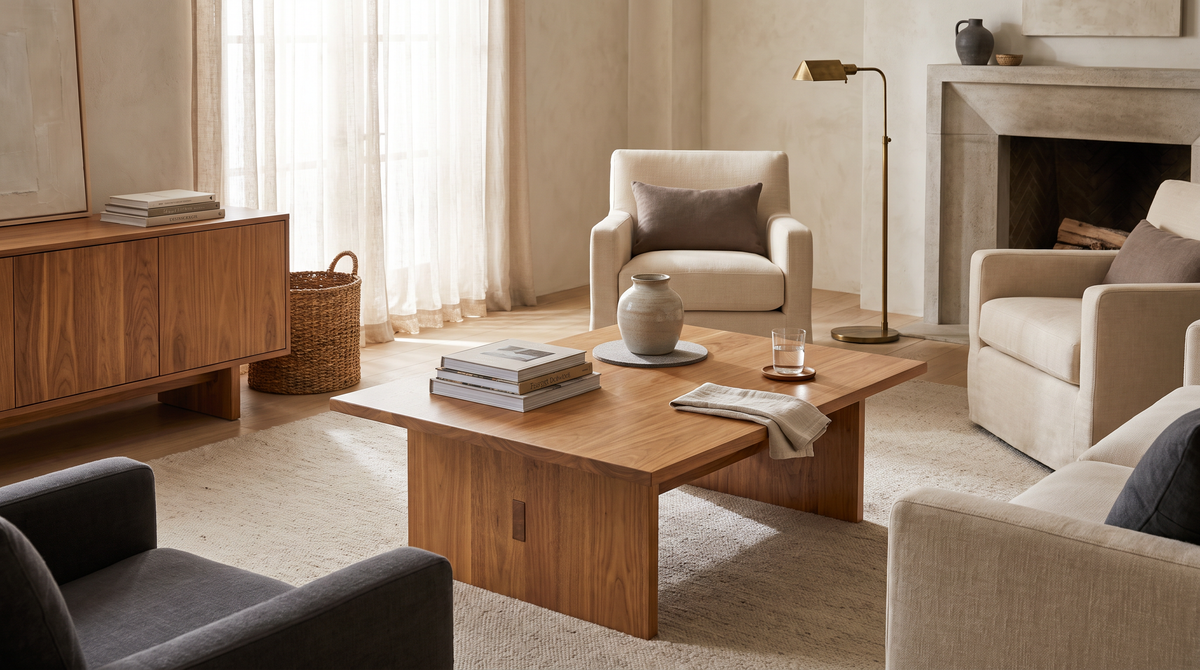
A rectangular coffee table is usually the natural choice for a long sofa, a narrow living room, or seating arranged along one wall. Its length follows the sofa’s profile, creates an easy-to-use surface, and can help anchor a long area rug.
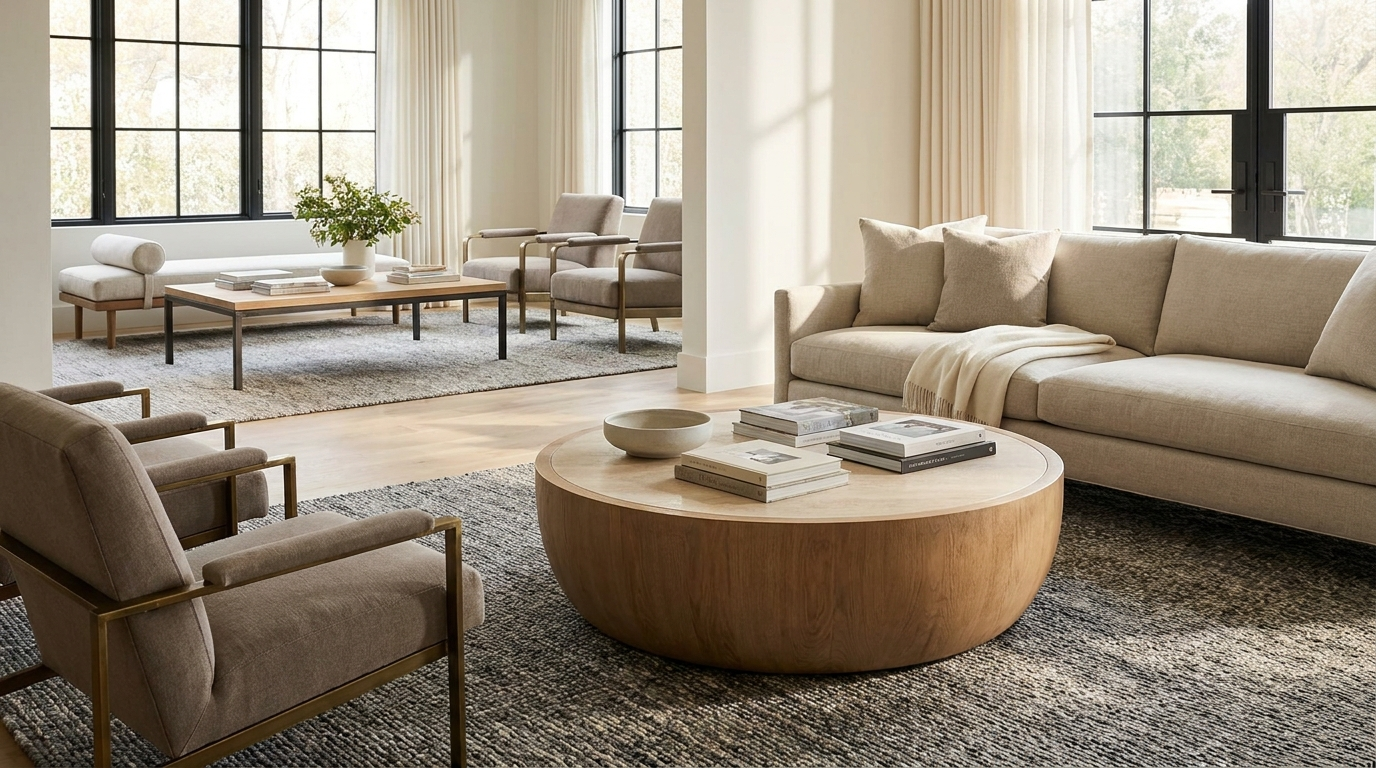
A round coffee table often works well in a compact or open seating arrangement, especially when chairs sit on several sides. Its curved edge can soften a room filled with straight lines and may make it easier to move around corners. It is also useful when you want the table to feel centered rather than oriented toward one long sofa.
For an L-shaped or U-shaped sectional, a round or square table can fit naturally inside the seating arrangement if the opening is broad enough. A rectangular table may be better when the sectional and room both have a clear, elongated direction.
The deciding factor is scale. A well-sized rectangular table will work better than an oversized round one, and a carefully measured round table will work better than a rectangular table that blocks the walkway.
Start With the Room, Not the Table
Before comparing finishes and materials, measure the space the table needs to occupy. Start with:
- The usable seating length of the sofa or longest side of the sectional
- The sofa-seat height, measured from the floor to the top of the cushion
- The distance between the seating and the opposite wall, media console, fireplace, or other furniture
- The location of doors, vents, stairs, and primary walkways
- The boundaries of the area rug
- The clearance needed to move chairs in and out comfortably
For a sectional, do not rely only on its full outside dimensions. On an L-shaped sectional, measure the longest usable seating side and the open interior area separately. A chaise may make the sectional look longer on paper without providing a practical surface along its full length.
Seat height matters, too. A very low table can be difficult to reach from a deep sofa, while a tall table can interrupt sightlines. As a starting point, look for a coffee table level with the sofa seat or about 1 to 2 inches lower. Ethan Allen’s coffee table guidance offers a similar recommendation. Compare the table with the actual seat cushion, not just the sofa frame, since cushions compress when occupied.
A simple floor test is one of the most useful steps in the process. Use painter’s tape, flattened cardboard, or newspaper to mark the proposed footprint. Sit on every seat, walk around the arrangement, open nearby doors, and check the route to the room’s main entrance. If the taped outline feels intrusive, the finished table will not solve the problem.
Coffee Table Size Guide for the Living Room
A useful coffee table size guide for the living room starts with proportion, not a universal dimension. As a starting point, look for a table approximately one-half to two-thirds the length of the sofa or longest usable side of the sectional. This proportion is also reflected in Wayfair’s coffee table sizing guidance.
For example, a 90-inch sofa could typically begin with a table about 45 to 60 inches long. That range is not a requirement. If the room has a narrow walkway, a chaise, or chairs close to the sofa, a smaller table may be the more successful choice.
The proportion gives the sofa a visual partner without allowing the table to overwhelm the seating. A table that is too short can look lost in front of a generous sofa and may leave people at either end reaching awkwardly. A table that is too long can crowd chairs, interrupt movement, and make the seating group feel tightly packed.
For a round table, apply the same principle to the usable seating arrangement, then choose the largest diameter that preserves comfortable access. A round table can have a generous surface, but its footprint expands in every direction. A narrow rectangular table may fit a small room more efficiently than a large circular one.
Also check the base. A pedestal can make it easier to pull up chairs, while wide legs or a storage shelf may reduce legroom even when the tabletop measurements appear appropriate. Exact product dimensions, overhangs, and base placement deserve a final check before ordering.
Coffee Table Spacing From Sofa and Chairs
A practical starting point is approximately 12 to 18 inches between the table edge and the nearest seating edge. This recommendation applies to the space between the coffee table and the sofa or chair—not to every walkway around the room. Wayfair’s spacing guidance provides the same general range.
That distance usually provides enough legroom while keeping drinks, books, and other items within reach. Less than 12 inches can feel restrictive, particularly with a deep sofa, loose cushions, or bulky table legs. More than 18 inches may create an uncomfortable gap and make the table feel detached from the conversation area.
Circulation beyond the table depends on the room’s traffic pattern. A frequently used route to a doorway, kitchen, or stairway needs more consideration than a quiet corner. Check the distance from the table to a media console, fireplace, wall, or other furniture, and leave enough room for people to pass without brushing against the table. The taped footprint test can help you judge this at several points, rather than from one seat alone.
Round Coffee Tables: When They Work Best
Round tables are especially effective in conversation-centered rooms where seating faces the table from several directions. With no single front edge, access may feel more evenly shared between a sofa and nearby chairs. That makes a round table a natural option for a compact sitting area, an apartment living room, or a room with two chairs opposite a small sofa.
Curved edges can also help where people move around the table frequently. In a room with a tight turn between the sofa and a doorway, removing a sharp corner may make the route feel less interrupted. The shape can soften a room dominated by rectangular windows, built-ins, straight sofas, and linear case goods.
Round tables can suit some chaise and sectional arrangements, but placement is essential. The diameter must fit inside the seating area without blocking the chaise’s lounging space or the open side of the sectional. A visually light base may help the arrangement feel less crowded, but it cannot compensate for insufficient clearance.
Do not assume that round automatically means better for a small room. A large circle can occupy more usable floor area than a narrow rectangle. Measure the diameter, test the footprint, and consider whether the tabletop provides enough room for the way you live. If you regularly serve snacks, work from the sofa, or keep books nearby, a smaller round surface may require more frequent clearing.
Rectangular Coffee Tables: When They Work Best
Rectangular tables are often the most practical fit for standard sofas, long seating walls, and narrow living rooms. Their linear form uses the space in the same direction as the sofa, which can make the arrangement feel orderly without requiring additional width.
The shape also provides a clearly oriented surface. There is room for a tray, books, drinks, a remote, and occasional work materials while leaving space for everyday use. A rectangular table can visually connect the sofa to a long rug and reinforce the geometry of a structured room.
This shape works particularly well when chairs sit at the short ends or across from the sofa. Before committing, make sure the table’s corners do not extend into a doorway or the route people use to enter the seating area. A table that fits neatly in front of the sofa may still be too long if it leaves little room beside an angled chair.
Rectangular does not mean formal or traditional. The right material, edge treatment, and base can suit contemporary, transitional, or relaxed interiors. The important consideration is whether the table’s length and corners support the room rather than compete with it.
What Is the Best Coffee Table Shape for a Sectional Sofa?
The best coffee table shape for a sectional depends on the interior opening, chaise direction, and relationship to the room’s walkways. Use the measurements above, but focus especially on the usable space inside the sectional rather than its overall footprint.
L-shaped sectionals
A round, square, or compact rectangular table can work inside an L-shaped sectional. Round tables are useful when the open side is a busy route or when the seating wraps around the table conversationally. A rectangular table may suit an elongated opening, provided it does not reach too close to the chaise or obstruct the route around the open end.
U-shaped and pit-style sectionals
A round or square table often creates a centered surface within a broad U-shaped arrangement. It can be reached from several seats and keep the visual focus in the middle of the group. The interior must be large enough to preserve legroom and allow people to enter and leave without squeezing between the table and cushions.
Chaise sectionals
With a chaise sectional, protect the chaise’s usable lounging area first. A round table may help maintain circulation around the open side, while a rectangular table can work along the longer, unobstructed edge. Avoid placing either shape where it forces people to step around the chaise or cross a primary walkway to reach the table.
A smaller table is often a better answer than one that fills the opening. Sectionals already have substantial visual and physical presence, so preserving a clear route can matter more than maximizing tabletop area.
Match the Shape to How You Live
Your routine should help settle the decision after the measurements are complete. If you frequently host friends, consider how many seats need access to the tabletop. A round table can serve several directions at once, while a rectangular one may offer more organized surface area for serving and storage.
Homes with young children may benefit from rounded or softened edges, particularly along a busy route, but a round shape does not remove every safety concern. Stable placement and attentive use still matter. Historical research has associated sharp-edged coffee tables with some child furniture injuries; the PubMed-indexed study should be understood as historical research, not current injury-rate data or a universal reason to reject rectangular tables.
If the room needs to change often, nesting tables or smaller movable pieces may be more useful than one large fixed footprint. For storage, evaluate shelves, drawers, lift tops, or baskets carefully. Storage can help, but a low shelf that catches feet or a bulky base that reduces legroom may undermine an otherwise well-sized table.
Styling a Round or Rectangular Coffee Table
Styling should reinforce the shape without taking away the surface you need. On a rectangular table, a tray can gather remotes, coasters, and smaller objects into one easy-to-move arrangement. Leave enough open space for a drink or book rather than filling the entire top.
On a round table, use a loose cluster or triangular composition instead of forcing objects into a straight line. A low bowl, a small stack of books, and one simple decorative object can create balance while preserving the table’s approachable, central quality.
Look at the surrounding shapes as you style. A round table can soften an angular sofa, rug, and built-in cabinetry. A rectangular table can echo the lines of a long sofa, fireplace, or nearby console. The goal is not to match every shape, but to create a room where the furniture feels deliberately related.
A Final Pre-Purchase Checklist
Before purchasing, confirm the following:
- Have you measured the sofa or sectional’s usable seating length?
- Is the proposed table roughly one-half to two-thirds of that length, or intentionally smaller to protect circulation?
- Is the tabletop level with or slightly below the sofa seat?
- Is there approximately 12 to 18 inches between the table and nearest seating edge?
- Are doors, vents, media furniture, and primary walkways unobstructed?
- Does the table fit inside the sectional’s usable interior area?
- Does the shape support how people enter, sit, serve, and move through the room?
- Have you tested the footprint with tape or cardboard?
- Have you confirmed exact product dimensions, including the base, overhangs, and storage components?
Make the Choice by Proportion and Use
A rectangular coffee table is usually the stronger fit for long, linear seating and narrow rooms where reach and alignment matter. A round table is often preferable when movement, softened edges, or conversation from several sides is the priority. For a sectional, let the interior opening and walkways decide rather than assuming one shape is required.
Measure first, test the footprint, and then choose the table that leaves enough room to live comfortably around it. When you are ready to compare coffee tables, explore Mercer & Gray's coffee table collection, and confirm each piece’s dimensions, height, and base placement before ordering.