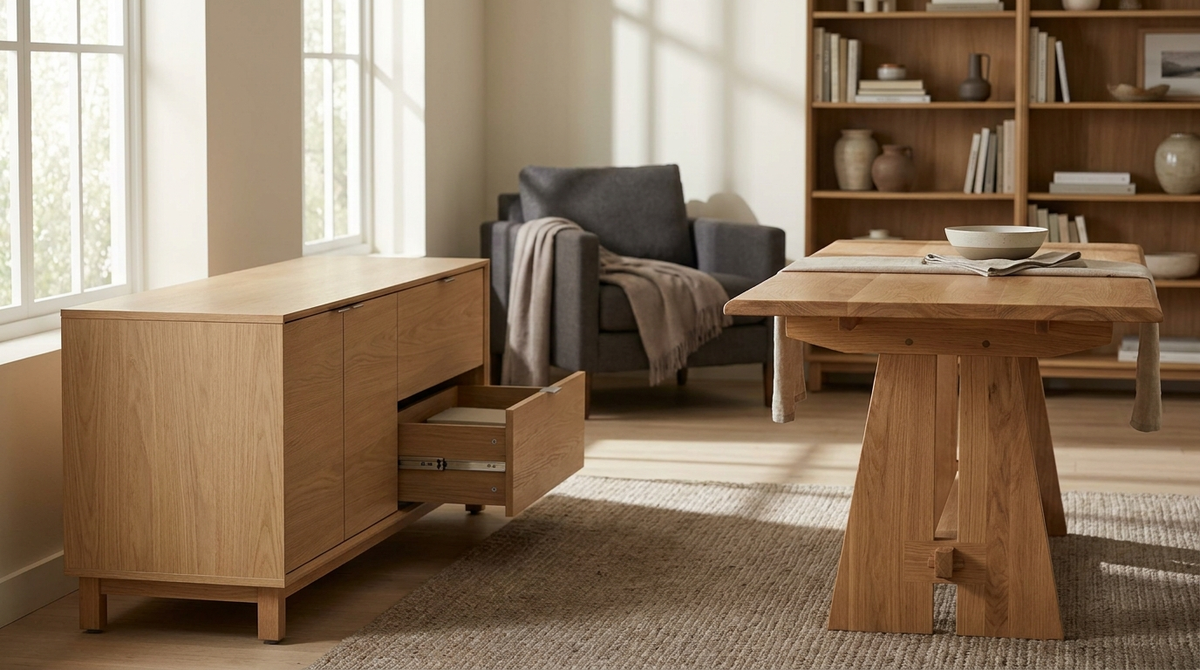
Quality Furniture vs. Flat-Pack: How to Tell What’s Built to Last
A polished flat-pack piece can look remarkably similar to a more expensive table or cabinet. So how can you tell whether the difference is meaningful? The useful comparison is not simply quality furniture vs. flat-pack. Flat-pack describes how furniture is packaged and assembled; quality describes its materials, structure, joinery, hardware and finish.
A well-designed ready-to-assemble piece can be a sensible choice for a guest room or rental. A poorly constructed solid-wood piece can still wobble, split or disappoint. To buy well, consider how you will use the furniture, how much wear it will receive, how long you want it to serve you and how much assembly or maintenance you are prepared to manage.
The guide below offers a practical way to assess those details before you buy.
Quality Furniture vs. Flat-Pack: What Are You Really Comparing?
Flat-pack, or ready-to-assemble, furniture is shipped in separate components and assembled at home. This can reduce shipping volume, make pieces easier to move through narrow stairways and keep prices more accessible. It says nothing by itself about the quality of the materials or the care taken in the design.
Quality furniture is best understood as furniture made with appropriate materials and construction for its intended use. It may arrive fully assembled, but it may also require some assembly. The more useful questions are specific:
- Is the case stable?
- Are the joints suited to the forces they will experience?
- Can the hardware be adjusted?
- Are vulnerable edges protected?
A flat-pack bookshelf in a lightly used home office may perform perfectly well if its panels, connectors and back are properly designed. A daily-use dining table, bed or entryway cabinet generally deserves closer scrutiny because it experiences repeated movement, weight and contact. Spend more thoughtfully on pieces that are difficult to replace or used every day; choose practical options where the demands are lower.
Start With the Materials: Solid Wood, Veneer, Plywood, MDF and Particleboard
Material descriptions provide useful clues, but none is a complete quality verdict. The better question is how each material is used and whether its properties suit the piece.
Solid Wood
Solid wood is cut from natural timber rather than formed into a panel. It brings visible grain, variation and the possibility of refinishing or repairing certain damage. It also responds to changes in humidity, so a well-designed piece needs construction that allows wood components to move without splitting or distorting. Solid wood is not automatically superior in every application, particularly for broad panels where movement can be difficult to manage.
Wood Veneer
Veneer is a real, thin layer of wood applied over a core, which may be plywood, MDF or another panel. A well-made veneer can provide an attractive, consistent surface and may be practical for wide cabinet doors or case sides. Inspect the core, edge treatment and overall construction rather than treating "veneer" as a warning sign.
Plywood
Plywood is made from layers of wood veneer bonded with alternating grain directions. Its layered structure can provide useful stability and strength, although quality varies by grade and application.
MDF
MDF is made from refined wood fibres combined with adhesive and pressed into a dense, smooth panel. It can provide an even surface for paint, but its edges and fastener connections need appropriate treatment.
Particleboard
Particleboard is made from wood particles bonded into a panel. It is widely used in furniture and cabinetry, and its performance depends on density, thickness, edge protection, fasteners and exposure to moisture. In the solid wood vs. particleboard furniture comparison, the important distinction is not simply natural versus manufactured. Look at the complete design, including how loads are supported and how connections are made.
MDF and particleboard are regulated composite wood products in applicable finished goods. When relevant, look for information showing compliance with TSCA Title VI, which addresses formaldehyde emissions from regulated composite wood components. Compliance is not a general measure of furniture quality, environmental superiority or toxin-free status, and it does not mean the product contains no other chemicals.
For more information, consult the EPA’s TSCA Title VI guidance.
| Material | Useful qualities | Points to inspect |
|---|---|---|
| Solid wood | Natural character; some repair and refinishing potential | Wood movement, end grain, seams and connection quality |
| Wood veneer | Real wood appearance; practical for broad panels | Core material, edge protection and veneer adhesion |
| Plywood | Layered structure; often stable for cases and shelves | Panel grade, thickness and edge finishing |
| MDF | Smooth, uniform surface; useful for painted components | Edge sealing, moisture exposure and fastening method |
| Particleboard | Accessible and widely used for panels | Density, supported spans, edge durability and connectors |
For a cabinet in a dry living room, a stable engineered core with a carefully applied wood veneer may be entirely appropriate. For a dining table, you may place greater value on the character and repair potential of a solid-wood top, provided the base and top are designed to work together.
How to Tell if Furniture Is Well Made
You do not need to be a furniture maker to assess construction. A few checks in a showroom—and a careful review of online specifications—can reveal more than a high price or a heavy box.
Start with the overall structure. Gently push a corner of a cabinet, table or bookcase. It should not rack dramatically from side to side, and doors should not shift noticeably when the case moves. Pronounced wobble or twisting is a reason to ask questions.
Look at corners, seams and exposed edges. Clean, tight connections and evenly finished surfaces suggest attention to detail. On panel furniture, edge banding or another edge treatment should sit securely rather than lift at the corners. Check the underside and back where possible; these areas often show whether the piece has been thoughtfully finished.
Operate every drawer and door. Drawers should travel smoothly, sit squarely and stop as intended. Doors should align and close without rubbing. Adjustable or replaceable hardware can be useful because hinges and slides are working parts. If a drawer bottom flexes noticeably or the box feels loose at the corners, consider how it will cope with repeated use.
Shelves also deserve attention. A long shelf with minimal support may sag under books, dishes or records. Look for a support system suited to the span and expected load, and check whether shelf pins or brackets fit securely.
The finish should feel even and smooth in high-contact areas. Inspect tabletops, drawer fronts and exposed edges for consistent coverage, sealed end grain and protection appropriate to the room. A beautiful finish cannot compensate for a weak case, while an uneven or poorly protected finish can make daily care more difficult.
Upholstered furniture requires a different inspection. Ask for clear information about the frame, suspension, cushion construction and fabric rather than judging the piece only by its silhouette.
When Shopping Online, Ask:
- What is each structural and visible component made from?
- Which parts are solid wood, and which are veneer or engineered panels?
- What joinery and hardware are used?
- Is assembly required, and how many components are involved?
- Are shelves, doors and drawers designed for the intended loads?
- Can worn or damaged hardware be adjusted or replaced?
- Does the product provide applicable TSCA Title VI compliance information for regulated composite wood components?
- Are assembly instructions available?
Material labels should distinguish solid wood, veneer, plywood, MDF and particleboard by component. A broad phrase such as “wood construction” is not a complete specification. Request clarification before treating a listing as a solid-wood piece.
Furniture Joinery Types and Durability
Joinery connects furniture components and helps a piece resist pulling, racking, twisting and the repeated force of opening drawers or leaning against a frame. Durability depends on fit, geometry, adhesive, reinforcement, material and intended use—not on a single impressive-sounding joint.
Dovetail Joints
Dovetails use interlocking, angled pins and tails. They are commonly associated with drawer boxes because the connection resists being pulled apart as the drawer opens. Look for a tight, clean fit and a drawer that remains square. A decorative or poorly fitted dovetail is less meaningful than a well-executed joint designed for the load.
Mortise-and-Tenon and Dowel Joints
A mortise-and-tenon joint places one component into a shaped opening in another. It is often used for legs, rails and frame construction, where a strong connection helps keep furniture square. Dowel joints can also perform well when holes are accurately placed, the fit is sound and the surrounding material is appropriate.
Dadoes, Rabbets and Mechanical Fasteners
A dado, rabbet or groove can help shelves, drawer bottoms and back panels stay aligned while increasing the surface available for connection. Screws, cams, brackets and corner blocks are not automatically signs of inferior furniture. They can be useful when a piece must ship flat, be disassembled for a move or be adjusted during installation.
The question is whether the connectors suit the panels, are installed precisely and are supported by a sound design. A flat-pack cabinet with sturdy connectors and a properly attached back may outperform a fully assembled cabinet with weak joints and poor alignment.
Flat-Pack Furniture: Where It Makes Sense—and Where to Be Selective
Flat-pack furniture can be a smart choice for guest rooms, rentals, temporary homes, children’s rooms and lightly used storage. It is also useful when you expect to move frequently or need a modular arrangement. In these situations, compact shipping, manageable cost and flexible replacement options may matter more than long-term repairability.
Depending on the manufacturer, replacement components may be easier or harder to obtain. Assess serviceability alongside the connector and panel design rather than assuming that flat-pack furniture is inherently easy—or difficult—to repair.
Be more selective with pieces used every day or asked to carry meaningful loads. Dining tables, beds, daily-use desks, heavily loaded bookcases, entryway storage and frequently opened cabinets deserve careful inspection. Look for sufficiently thick panels, durable edges, well-designed connectors, a back panel that contributes to rigidity and feet that allow the piece to sit level.
Read the assembly instructions before buying if they are available. Clear steps, accurate diagrams and sensible hardware are encouraging signs. During assembly, do not force misaligned parts or compensate for a crooked base by tightening one connector excessively. Over-tightening can damage a panel, while under-tightening can leave movement that stresses the connections.
Set the piece on a level surface and follow the manufacturer’s guidance for anchoring tall or tip-prone furniture. Correct assembly is part of the product’s performance, not an administrative detail.
Match Construction to the Room and the Way You Live
The right standard changes from room to room. A cabinet used for occasional linens does not face the same demands as a sideboard opened several times a day or a desk supporting work equipment for hours at a time.
Living Room
Prioritise a stable frame, dependable doors and drawers, useful shelf support and a finish suited to daily contact. A coffee table should feel secure when people lean against it, while a media or storage cabinet needs a rigid case and hardware that can tolerate repeated use.
Dining Room
Inspect the relationship between the tabletop, legs and supporting rails. The base should feel stable, and the top should have a finish appropriate to meals, spills and regular cleaning. Also consider surrounding clearance so chairs can move comfortably.
Bedroom
For a bed, focus on stable connections, quiet performance, supported slats or platform construction and clear assembly instructions. For dressers and nightstands, assess drawer alignment, slide quality and resistance to racking. Follow the manufacturer’s instructions for anchoring storage furniture where required.
Home Office and Entryway
A daily desk needs a steady work surface, suitable equipment support and connections that will not loosen easily through ordinary use. Check drawer slides, cable-management components and stated load information.
Entryways receive frequent contact, dirt and hurried movement. Favour practical finishes, sealed edges and hardware designed for repeated opening. A simpler cabinet with sound construction may be more useful than a delicate piece chosen only for appearance.
Care and Assembly Practices That Protect Furniture Quality
Good construction still benefits from appropriate care. Assemble furniture on a level, protected surface so finished panels are not scratched and the case is not forced out of square. Keep the instructions for future moves, adjustments or repairs.
Lift furniture rather than dragging it whenever possible. Distribute books, dishes and office equipment across supported areas instead of concentrating heavy items at the centre of a long, unsupported shelf.
Protect wood furniture from prolonged moisture and, where practical, intense direct heat or sunlight. Use cleaning products suited to the finish and avoid leaving excess water on porous surfaces or unsealed edges. Adjust hardware only as the manufacturer directs; more force is not a substitute for correct alignment.
A Simple Furniture-Buying Checklist
Save this checklist for your next showroom visit or online purchase:
- Material: What is each visible and structural component made from?
- Construction: Does the piece remain square and stable under light pressure?
- Joinery: Are the connections appropriate, cleanly fitted and reinforced where needed?
- Hardware: Do drawers, doors, slides, hinges and connectors operate smoothly?
- Finish: Are surfaces and vulnerable edges evenly finished and protected?
- Use: Can the piece handle the room’s expected load and frequency of use?
- Assembly: Can you assemble it accurately, level it and anchor it safely if necessary?
- Compliance: Does it provide applicable TSCA Title VI information for regulated composite wood components?
- Value: Does the construction match the years and intensity of use you expect?
When to Choose Quality Furniture—and When Flat-Pack Is the Better Fit
Choose more substantial construction when a piece is used daily, carries meaningful weight, anchors the room or would be difficult and expensive to replace. A dining table, bed, well-used desk or main living-room storage piece may justify closer attention to solid components, stable panels, joinery and serviceable hardware.
Choose flat-pack when convenience, price, compact shipping, modularity or flexible replacement options are the more important priorities. It can be an appropriate choice for occasional furniture, temporary arrangements and rooms where demands are modest. The key is to inspect the piece honestly rather than assume its packaging tells you everything.
The strongest buying decision is proportionate: put your budget toward the construction and materials that matter most in your home, then use simpler options where furniture has a lighter role.
Explore Mercer & Gray’s collection to find a piece suited to your room, intended use and priorities.