How to Choose Dining Room Lighting for a Solid Wood Table
A beautiful solid wood dining table naturally brings warmth, texture and character into a room. The right lighting should enhance those qualities — highlighting the natural wood grain, creating an inviting atmosphere and providing enough practical light for everything from family dinners to entertaining.
Choosing the best dining room lighting for a solid wood table starts with the table itself. Its shape, size and proportions can help determine whether a chandelier, linear pendant or group of pendants will work best.
From fixture size and hanging height to warm white bulbs and dimming, here's how to create a dining space that feels beautifully considered by day and welcoming after dark.
Dining Room Lighting Measurements at a Glance
Before choosing a fixture, these measurements provide a useful starting point:
- Fixture width: Start at around half the width of your dining table, or consider a fixture approximately 12 inches narrower than the tabletop.
- Fixture length: For rectangular tables, consider the fixture's length separately so it complements the table without overwhelming it.
- Hanging height: Aim for approximately 30–36 inches between the tabletop and the lowest point of the fixture.
- Multiple pendants: Start with around 18–24 inches of clear space between medium-sized shades.
- Bulb colour temperature: Look for approximately 2700K–3000K for warm, welcoming dining room lighting.
These are useful guidelines rather than strict rules. Ceiling height, room size and the visual weight of both the table and light fixture should influence your final choice.
Match Your Lighting to the Shape of Your Dining Table
The shape of your table is one of the easiest places to begin.
Your light fixture doesn't have to replicate the table's shape exactly, but complementary proportions can make the entire dining area feel more cohesive.
Chandeliers Above Round and Square Dining Tables
A centred chandelier or pendant works particularly well above a round or square solid wood dining table.
The central shape naturally follows the table's proportions and can distribute light evenly across the dining area.
If your table and chairs already have plenty of visual weight, consider an open chandelier rather than a large opaque shade. This provides presence above the table without making a smaller dining room feel crowded.
Linear Lighting Above Rectangular Dining Tables
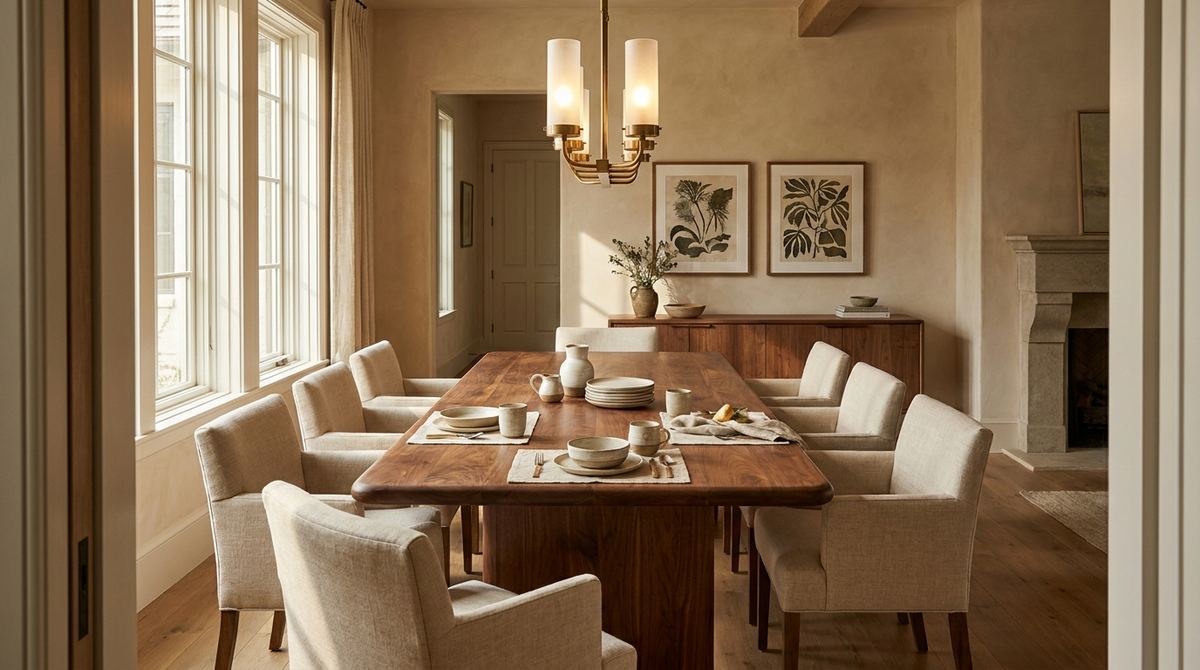
Longer rectangular tables generally work beautifully with a linear chandelier or elongated pendant light.
Following the length of the tabletop helps visually connect the light and furniture while distributing illumination across a larger dining surface.
For particularly long dining tables, consider using two or three individual pendants rather than one oversized fixture.
If you're using multiple pendants, repeat at least one design element — such as the shade shape, material, finish or bulb style — to keep the arrangement feeling intentional.
Looking for the table first? Browse the Mercer & Gray dining furniture collection to explore solid wood tables and complementary dining furniture.
How to Choose the Right Chandelier Size for Your Dining Table
Start by measuring your table's width.
As a general shopping guide, compare fixtures around half the width of your table with options approximately 12 inches narrower than the tabletop.
These aren't fixed specifications. A delicate open-frame chandelier will appear considerably lighter than an opaque fixture with exactly the same dimensions.
For rectangular tables, you'll also need to consider length.
The fixture should have enough presence to relate to the full tabletop without extending so far that it begins to compete with the chairs or surrounding circulation space.
If you own an extendable dining table, it's usually best to choose your lighting based on its everyday dimensions unless you regularly use the table fully extended.
Example: Lighting a 72 × 36-Inch Dining Table
For a dining table measuring 72 inches long by 36 inches wide:
- Half the table width is 18 inches.
- Twelve inches narrower than the tabletop is 24 inches.
- You could therefore begin by comparing fixtures around this general width range.
- Then consider the fixture's length separately to ensure it feels proportional to the 72-inch tabletop.
An open or visually lightweight fixture gives you more flexibility than a dense, heavy chandelier.
Designer tip: Before ordering, mark the proposed dimensions on the ceiling with painter's tape or create a simple cardboard template. Look at it both while seated at the table and when entering the room. It's a surprisingly effective way to judge scale.
How High Should a Dining Room Light Hang Above the Table?
A useful starting point is approximately 30–36 inches between the dining table and the lowest point of the light fixture.
However, the ideal height also depends on:
- Ceiling height
- Fixture depth
- Shade size and opacity
- Sightlines across the table
- Room proportions
- The height of the people regularly using the space
A fixture hung too low can obstruct conversation and sightlines. Too high, and it can lose its visual relationship with the dining table.
In an open-plan home, don't assess the fixture only while sitting underneath it. Look at it from the kitchen, living room and main walkways too.
Adjustable rods, chains or cords can be particularly helpful when fine-tuning the final position.
How to Space Pendant Lights Over a Dining Table
Pendant lighting over a dining table is a great alternative to one large chandelier, particularly over a long solid wood table.
Begin with the centreline of the table and position the pendants so that the complete arrangement has comfortable space at either end.
For medium pendants, around 18–24 inches of clear edge-to-edge space between shades provides a useful starting point.
Larger shades generally require more room, while smaller pendants may work closer together.
Also consider glare. Exposed bulbs can look beautiful but may become uncomfortable when they're directly within someone's eyeline.
Frosted bulbs, diffused shades or downward-facing pendants can create softer illumination across the tabletop.
What Color Light Is Best for a Dining Room?
For most dining rooms, warm white bulbs between 2700K and 3000K provide an inviting balance.
Kelvin — shown as "K" on bulb packaging — describes the appearance or color temperature of the light.
2700K creates a warmer, softer atmosphere that's particularly effective for intimate or traditional dining spaces.
3000K feels slightly cleaner while retaining enough warmth to complement natural wood.
Your table finish and surrounding colors matter too. Dark timber, cream walls and warm flooring can appear particularly golden beneath very warm lighting, while rooms receiving cooler natural daylight may benefit from something closer to 3000K.
Lumens vs Watts
Don't rely on wattage when comparing modern bulbs.
Watts measure energy consumption. Lumens measure visible light output.
As a rough reference, an 800-lumen LED can provide brightness comparable to a traditional 60-watt incandescent bulb.
The amount of light your dining room actually needs will depend on its size, the fixture design, shade opacity and other sources of light in the space.
Don't Forget CRI
CRI — or Color Rendering Index — indicates how accurately colors appear beneath a light source.
Choosing a higher-CRI bulb can help the natural tones of solid wood, ceramics, linens and food appear richer and more natural.
It's particularly worth considering when you've invested in a dining table because of the beauty of its natural grain and finish.
Add a Dimmer for Flexible Dining Room Lighting
Your dining table probably serves more than one purpose.
It might be the setting for breakfast in the morning, homework in the afternoon, family dinner in the evening and entertaining at the weekend.
A dimmer allows the same lighting fixture to accommodate all of them.
Choose bulbs specifically labelled dimmable and make sure they're compatible with both your fixture and installed dimmer.
Some warm-dim LED bulbs also become warmer in color as they're dimmed, helping create a softer atmosphere for evening dining.
Layer Your Dining Room Lighting
The pendant or chandelier above your table doesn't need to provide every source of light in the room.
In fact, the most inviting dining rooms usually use layered lighting.
Consider combining your central fixture with:
- Wall sconces
- A picture light above artwork
- Recessed lighting
- A table lamp on a sideboard or console
- Subtle lighting from an adjoining kitchen or living space
This allows you to lower the main dining light without leaving the surrounding room feeling dark.
A softly illuminated solid wood sideboard or cabinet can also create another visual layer while providing practical dining room storage.
How to Match Lighting With a Solid Wood Dining Table
Your light fixture doesn't need to match your table's wood finish.
In many cases, contrast creates a much more interesting interior.
Consider combinations such as:
- Warm wood + black metal: Modern and architectural
- Natural wood + aged brass: Warm and sophisticated
- Dark wood + glass: Light and elegant
- Solid wood + linen shades: Soft and organic
- Straight-edged table + rounded lighting: A beautiful way to soften strong geometry
Think about the room as a whole rather than trying to match every individual finish.
Dining chairs, flooring, wall colors, cabinet hardware, tableware and surrounding furniture all contribute to the palette.
Repeating one or two materials or finishes is usually enough to create cohesion.
The solid wood dining table should remain the anchor, with the lighting adding proportion, contrast and atmosphere around it.
Common Dining Room Lighting Mistakes to Avoid
Even a beautiful fixture can feel wrong if its proportions or positioning aren't quite right.
Watch out for these common mistakes:
- Choosing a fixture that's too small for a long dining table
- Hanging the fixture too high above the tabletop
- Hanging it low enough to obstruct conversation
- Using exposed bulbs that create uncomfortable glare
- Choosing very cool bulbs that flatten warm wood tones
- Relying only on the central ceiling light
- Forgetting to check how the fixture looks from elsewhere in an open-plan room
- Matching every material and finish too precisely
The goal isn't perfect matching — it's balance.
Dining Room Lighting Buying Checklist
Before ordering your lighting, make a note of your dining table's length and width, your ceiling height and the complete dimensions of the proposed fixture.
Then check:
- The fixture is suitable for its intended indoor location.
- The proportions work with the table and surrounding room.
- The bulbs fit the fixture's socket and shade requirements.
- The lumen output provides enough usable light.
- The color temperature creates the atmosphere you want.
- The CRI is appropriate for natural-looking colors.
- Bulbs and dimmer controls are compatible.
- The rods, chain or cord allow your preferred hanging height.
- The ceiling box and support can safely accommodate the fixture's weight.
- Installation requirements are understood before purchase.
If you're uncertain about wiring or structural support, always consult a qualified electrician.
Start With the Dining Table
Choosing the right dining room lighting becomes much easier when you make the table your starting point.
First, consider its shape and dimensions. Then choose a fixture with complementary proportions, establish the right hanging height and select warm, flattering bulbs. Finally, introduce dimming and secondary lighting to create flexibility throughout the day.
The best dining room lighting shouldn't overpower a beautiful solid wood table. It should make its natural grain, color and craftsmanship look even better while creating a space where people genuinely want to sit, eat and spend time together.
If you're designing or refreshing your dining space, explore Mercer & Gray's dining furniture collection for solid wood dining tables, seating and complementary furniture.