Best Accent Chairs for Small Spaces: How to Choose a Comfortable, Well-Scaled Seat
An Accent Chair Can Transform a Small Space
An accent chair can add seating, personality, and a useful secondary zone to a small room, but the wrong one can obstruct circulation and make the space feel crowded. The best accent chairs for small spaces balance a manageable footprint with visual lightness, everyday comfort, and a clear purpose.
Before you buy, consider four things together: how much floor space the chair occupies, how it relates to your sofa and coffee table, how comfortable it is for the way you sit, and how people will move around it. A well-chosen chair can make a compact living room feel more complete without making it feel overfurnished.
Why an Accent Chair Can Work in a Small Space
One thoughtfully placed chair can provide the extra seat a room needs without requiring a larger sofa or sectional. It can also give an underused corner a specific role: a reading spot beside a window, a conversation seat across from the sofa, or a compact perch near a desk or bedroom dresser.
Start with the chair’s purpose. In an apartment living room, one chair angled toward the sofa may create a more natural conversation area than two chairs squeezed against opposite walls. In a bedroom, a narrow chair can make a corner useful without competing with the bed or storage furniture.
Visual weight matters alongside measured size. Exposed legs, open sides, and a simpler frame allow more of the floor to remain visible, which may help a room feel less crowded. This is a styling advantage, not a substitute for accurate measurements: a petite chair with a bulky silhouette can still dominate a small space.
The Best Accent Chair Styles for Small Rooms
Different chair shapes suit different activities. Use the guide below as a starting point, then evaluate the specific chair’s dimensions and comfort.
| Style | Well Suited To | Watch For |
|---|---|---|
| Slipper chair | Occasional seating, bedrooms, conversation | Armless designs offer less support; seat height varies |
| Slim armchair | Reading, conversation, everyday seating | Wide arms can reduce usable seat width |
| Barrel chair | Reading corners and occasional seating | Rounded backs may add depth and restrict posture |
| Swivel chair | Open-plan rooms and flexible conversation areas | Rotation requires additional clearance |
| Raised-frame chair | Small rooms where visual openness matters | An open base does not compensate for excessive width or depth |
Slipper Chairs
Slipper chairs are generally armless and streamlined, making them easy to position in bedrooms, dining-adjacent areas, entry zones, and occasional seating arrangements. Their seat height varies by design, so do not assume that every slipper chair sits low.
Their upright shape is often better for short visits or conversation than extended lounging. If the chair will be used for daily reading or television, check the back angle and seat depth rather than choosing one on appearance alone.
Slim Armchairs
A slim armchair offers arm support without the broad, heavily padded footprint of a club chair. Arms can make it easier to sit down, stand up, or settle in with a book.
Compare both the overall width and the interior seat width. Two modest-looking arms can substantially reduce usable seating space, so a chair that appears compact may feel narrow once occupied.
Barrel Chairs
Barrel chairs are often compact across the front, but their rounded backs can make them deeper than they appear. The curved shape can feel inviting in a corner or beside a small side table, provided the actual footprint works in the room.
A barrel chair can suit a reading nook if its seat supports an upright posture. A deep, rounded seat may require a lumbar pillow for shorter users.
Swivel Chairs
A swivel chair can connect two areas in an open-plan home. You might face it toward the living room for conversation, then turn it toward the kitchen while hosting or keeping an eye on nearby activity.
The listed footprint is not the whole story. Leave enough surrounding space for rotation so the chair does not strike a wall, table, lamp, or walkway. A swivel is useful only when it can move freely without disrupting the room.
Raised-Frame Chairs
Chairs with visible legs or an open base preserve floor sightlines beneath the seat and may reduce visual heaviness. The benefit depends on the chair’s scale, surrounding furniture, and placement. A raised chair that is too wide, too deep, or out of proportion with the sofa will still feel oversized.
Deep lounge chairs, oversized club chairs, and recliners are not automatically off-limits. They simply need a dedicated footprint and may work better as the room’s primary accent than as an additional piece in an already full arrangement.
Accent Chair Dimensions for Small Rooms
There is no universal definition of a small accent chair. As a planning range, some small-space chairs measure approximately 28–31 inches wide and 28–36 inches deep, but styles and proportions vary substantially. Treat these figures as examples, not standards.
Overall dimensions tell only part of the story. Compare:
- Overall width: the floor and wall space the chair occupies.
- Overall depth: the distance from the front of the seat to the furthest point of the back frame.
- Seat width: the usable sitting area after the arms are accounted for.
- Seat depth: how supported or relaxed your sitting position will feel.
- Seat height: how easily you can sit down and stand up, and how the chair relates to the sofa.
- Arm and back height: the level of support and the chair’s visual presence.
A chair’s overall depth is not the same as its usable seat depth. A deep frame may contain a thick back cushion, leaving a sitting area that feels much shallower than expected. Conversely, a generous seat may allow you to sink back farther than is comfortable for your height.
Some seating guidance uses figures around 18–19 inches for seat depth and 15–16 inches for seat height. These are illustrative dimensions, not universal comfort standards. Your body proportions, posture, and intended use matter more than a generic label such as “compact.”
Compare the chair’s seat height with your sofa for visual balance, but do not force an exact match. A lower chair may look relaxed while being less convenient for some adults to enter and leave.
Before purchasing, mark the proposed footprint with painter’s tape or make a cardboard template using the chair’s maximum width and depth. Include nearby tables, lamps, vents, and the space needed to approach and use the chair.
How to Measure the Room Before You Buy
Measure the usable floor zone rather than only the open wall length. Account for baseboards, radiators, vents, windows, outlets, door swings, curtains, and nearby furniture.
For a swivel chair, recliner, or chair paired with an ottoman, mark the operating area as well as the chair itself. A piece may fit within a corner but still interfere with a frequently used route once someone sits, swivels, reclines, or extends their legs.
Protect the room’s main walkway. The appropriate clearance depends on the layout, so evaluate the actual path rather than relying on a single universal number. People should be able to approach the chair without turning sideways or navigating around the coffee table.
Delivery access deserves equal attention. Measure the entry door, hallway, elevator, stairwell, ceiling height, and tight turns. If the chair must be tilted, check its diagonal depth or height as well. A chair that fits the room is not a successful purchase if it cannot reach the room.
How to Choose a Comfortable Accent Chair
Comfortable accent chairs for small spaces begin with intended use. A chair for occasional guests can have a different shape from one used every evening for reading, working beside a laptop, or watching television.
If possible, sit with your back supported and your feet comfortably grounded. Notice whether the seat depth allows you to use the back cushion without leaving your feet unsupported. Assess seat height, cushion firmness, back angle, lumbar support, and arm height. A structured, shallower chair generally encourages upright conversation; a deeper chair supports a more relaxed posture but may need a pillow for shorter users.
Online shoppers should look for complete dimensions, customer photographs, fabric swatches, assembly details, and a clearly stated return policy. If a showroom visit is possible, sit for more than a few seconds and try the position you will actually use at home.
Upholstery and Care Considerations
Choose upholstery according to the household’s real conditions. Pets, children, direct sunlight, food and drink, frequency of use, and your willingness to maintain the fabric all matter more than a color name or marketing label.
Request a fabric swatch before committing to a larger upholstered piece. Screen color can vary, while texture and weave may look different in natural daylight. A swatch also lets you see how the material relates to your sofa, rug, wood furniture, and wall color.
Removable covers can make care simpler, but do not assume they are machine-washable. Follow the manufacturer’s cleaning code and care instructions. “Performance fabric” describes a category of materials with varying construction, finishes, testing, and maintenance requirements; it does not automatically mean stain-proof or indestructible.
If recycled content, natural fibers, certifications, or material-sourcing claims influence your decision, check the documentation for the specific chair and upholstery. Such claims must be verified product by product.
Placement and Styling Ideas for Apartment Living Rooms
In a compact living room, place one chair diagonally across from the sofa to create a conversation zone without forming a rigid row. Angle it enough to feel welcoming while keeping its legs clear of the main walkway.
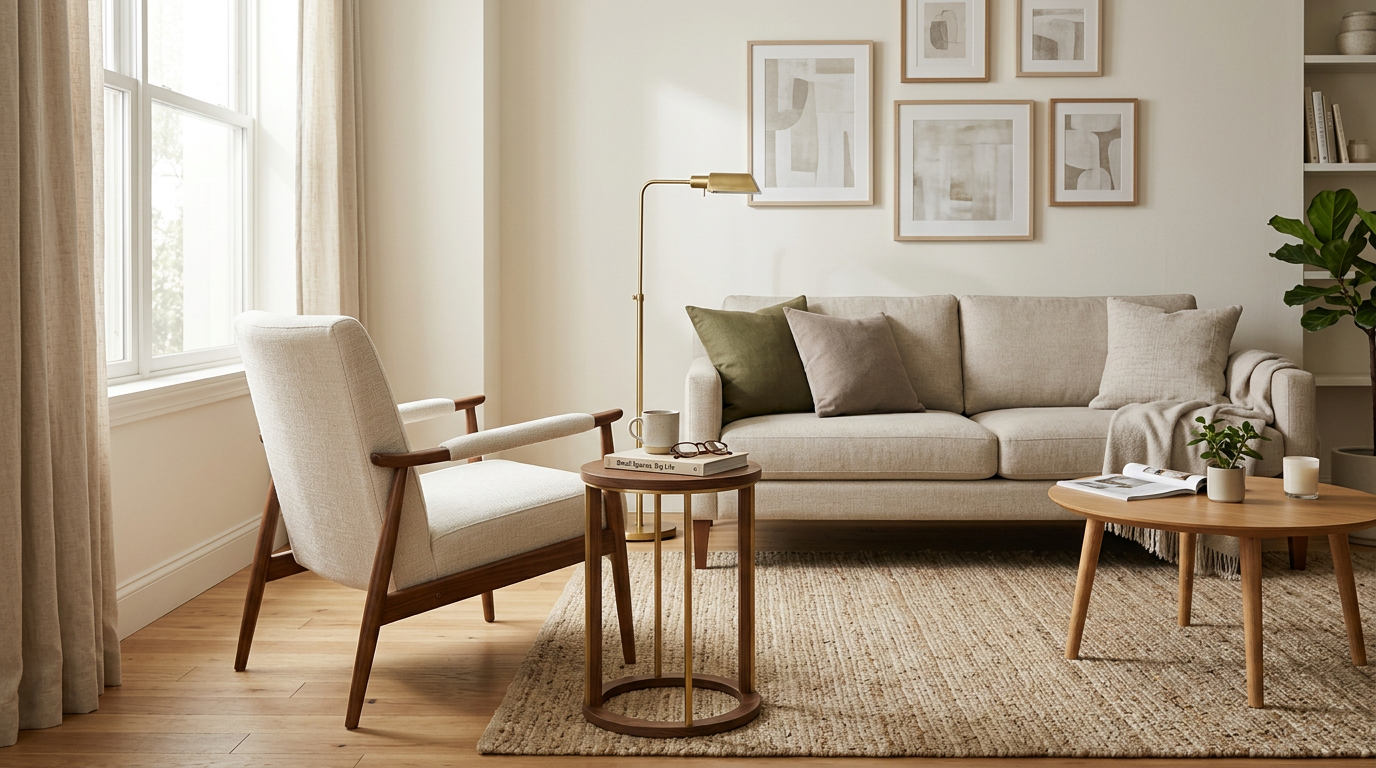
A chair beside a window can become a compact reading nook. Add a slim side table and a floor or wall-mounted light, but leave room for curtains, window operation, and comfortable entry. Depending on its scale and placement, a small table with an open base may provide more visual breathing room than a wide, enclosed piece.
In an open-plan apartment, a swivel chair can bridge the living area and kitchen or dining zone. Its ability to turn may make one seat more versatile, provided the surrounding area allows that movement.
An area rug can visually connect the chair to the sofa and coffee table, but do not let the rug, table, or chair narrow the walkable path. Coordinate the chair through one or two shared details—such as a wood tone, linen texture, metal finish, color, or curved shape—rather than matching every item exactly.
Common Small-Space Accent Chair Mistakes to Avoid
The most common mistake is buying from a product photograph without checking exact dimensions. Images can make a chair appear smaller and distort its relationship to the room.
Other problems include relying on overall width while ignoring seat width or depth, choosing a deep chair beside a narrow walkway, and placing a swivel where it cannot rotate. A delicate-looking frame may also be poorly suited to heavy daily use if its upholstery and construction have not been reviewed.
Avoid filling an already busy room with multiple small pieces simply because each one fits individually. One chair with a clear role is often more useful than several undersized pieces competing for attention.
A Simple Checklist for Choosing the Right Chair
Before you place an order, ask:
- What will the chair be used for: reading, conversation, guests, desk work, or lounging?
- What are the maximum width, depth, and height limits in the room?
- What are the chair’s seat width, seat depth, and seat height—not just its overall width?
- Will it interfere with circulation, doors, windows, vents, or other furniture?
- Does its silhouette balance the sofa and coffee table?
- Can the upholstery suit the household’s traffic, pets, children, light, and maintenance habits?
- Will the chair fit through the full delivery route?
- Does it add a useful function, or is it only occupying an empty corner?
The best accent chairs for small spaces support the way your home is actually used. Measure the room and delivery route twice, compare complete specifications, and prioritize comfort and proportion before trend or appearance. Once the chair has a clear purpose, explore Mercer & Gray's accent chair collection to find options whose individual dimensions can be evaluated for your space.